09.02.25 By Bridgenext Think Tank

In 2025, industry leaders have moved well beyond questioning the value of data analytics to accelerate its tangible impact across every facet of the supply chain. Confronted with increasing cost pressures, evolving customer demands, ambitious sustainability mandates, and persistent supply chain volatility, analytics has rapidly become integral to executive strategy.
Today, advanced analytics is foundational to critical logistics decisions, from optimizing last-mile operations and orchestrating autonomous warehouses to building agile, resilient networks. The growing divide between data-driven innovators and traditional operators is reshaping the competitive landscape, with analytics serving as a key differentiator.
The last mile remains one of the biggest cost drivers, accounting for up to 41% of logistics expenses in 2025. Predictive analytics and AI-powered routing are enabling companies to anticipate disruptions, reroute in real time, and transform last-mile performance into a profit lever rather than a cost sink.
Similarly, real-time visibility has emerged as a differentiator. IoT sensors, telematics, and control tower systems now allow providers to track shipments minute-by-minute, mitigate risks before they escalate, and offer customers accurate ETAs, all of which directly improve trust and service quality.
Inside warehouses, autonomous mobile robots (AMRs) and AI-driven workflows are increasing throughput, easing labor shortages, and enabling strategic deployment of human talent for higher-value work.
Transportation Insight (TI) recently modernized its analytics, addressing the challenges of a legacy ETL system with rising data complexity, slow processing, and high costs. Partnering with Bridgenext, TI built a cloud-native data environment using Databricks Delta Lake, Azure Data Factory, and Snowflake.
The results were significant:
Read this case study to learn how advanced analytics and modern data architecture drive operational excellence, innovation, and better outcomes for stakeholders.
Integrated data ecosystems unify carrier, fleet, warehouse, and customer intelligence, equipping organizations to respond instantly to capacity fluctuations, route changes, and inventory variances.
Predictive analytics anticipates demand surges, capacity constraints, and potential risks. Prescriptive analytics goes further, recommending the best possible action, whether it’s rerouting freight or adjusting supplier schedules.
Seamless integration of ERP, WMS, TMS, and CRM platforms removes traditional silos, reduces latency, and pushes analytics capabilities to the network edge, accelerating time-to-insight and empowering decisions at every level.
Modern analytics tools now optimize not only for cost, but also for environmental impact, supporting regulatory compliance and advancing customer-aligned, sustainable logistics strategies.
Despite significant progress, the journey towards analytics maturity presents ongoing challenges:
This year, the most impactful logistics use cases result from fusing internal operational data with external inputs, including live telematics, compliance data, and environmental feeds. This confluence creates the intelligence architecture required for truly proactive decision-making.
Data lakehouse solutions, sometimes called “data reservoirs,” can hold any amount of data, regardless of type or how it is stored. With machine learning (ML), big data processing, real-time analysis, and visualization dashboards, analytics, and insights, for more informed decisions can be achieved from this central repository.
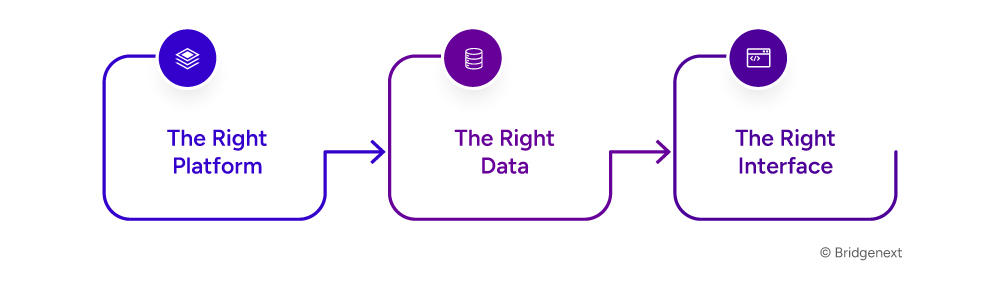
So, what are the prerequisites for a productive data lake? Like with any endeavor, alignment with the business goals, executive sponsorship, and general support are key. Based on our experience with dozens of companies utilizing data lakes with varying degrees of success, these three conditions are crucial:
As we reach the midpoint of this transformation, a pivotal trend is clear: data analytics and AI has become an operational imperative within logistics. The organizations outpacing their peers are those that treat data as a foundational asset, fully integrating analytics into every process, decision, and customer engagement.
The remainder of this year and next will favor logistics leaders who:
At Bridgenext, we enable logistics innovators to harness the transformative power of advanced analytics. By simplifying system integration, architecting resilient data environments, and applying AI-powered intelligence, our clients achieve:
The advantages in 2026 will go to organizations that turn insight into action, quickly, decisively, and at scale. We partner with transportation and logistics leaders to deliver measurable impact in months, not years, enabling a future-ready, analytics-driven approach to logistics success.
Contact us to get started on your enterprise data analytics journey.