04.14.26 By Bridgenext Think Tank

Insurers have invested millions in advanced pricing models and predictive analytics, yet underwriting results still lag. Combined ratios have repeatedly exceeded 100 in recent years, and fewer than 20% of carriers fully trust the data behind their underwriting decisions. The problem is the fragmented, inconsistent data feeding those models, and it shows up as mispriced policies, inconsistent risk selection, and volatile loss ratios.
Read on to see exactly where that data breaks down, and how to build a resilient data foundation that protects your margins.
Master data management (MDM) in insurance underwriting is the discipline of creating a single, trusted version of risk-entity data so that every downstream system reads the same accurate record rather than conflicting, duplicated ones. When MDM is missing or broken, underwriters end up manually reconciling mismatched data, and pricing models make decisions on incomplete risk pictures.
A single risk entity, one commercial account, one policyholder, often exists as three or more disconnected records across policy administration, claims, and billing systems. When these records aren’t linked, pricing engines make decisions on incomplete risk data, and underwriters must manually catch and correct the gap.
Imagine a single mid-sized commercial account that has three separate entities across your systems: one ID in policy administration, another in claims, and a third in billing. Your pricing engine reads the first record and assesses it as low exposure. However, the claims system, linked to a different ID, reveals a history of major losses. The underwriter spots the conflict and immediately overrides the model’s quote. This is master data management failure at its most destructive. This fractured identity occurs where the most critical business decisions happen.
The operational drag this creates is measurable:
The business impact is undeniable: underwriting assumptions rest on mismatched inputs, and trust in your costly analytics investments quietly vanishes.
When data architecture breaks down, the financial impact ripples through every underwriting decision. Here is how Master Data Management (MDM) failures directly erode your profitability:
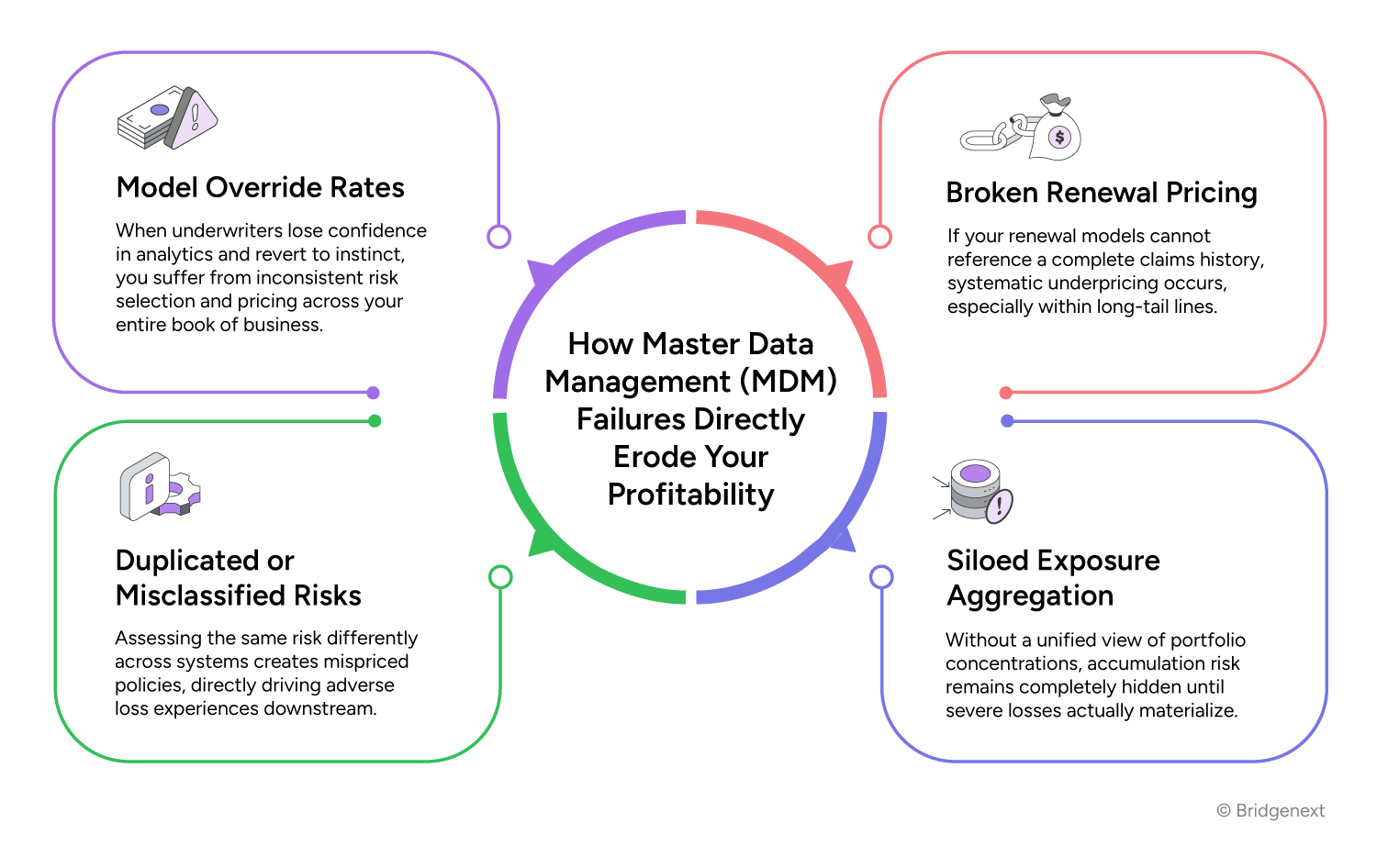
Fragmented master data doesn’t stay a back-office problem; it flows directly into your loss ratio, combined ratio, and operating profit. Carriers with unified, well-governed data report measurably better underwriting outcomes than those still operating on siloed systems.
What the data shows:
Your competitors are optimizing their pricing models using unified, reliable data. By not focusing on your data architecture, you are handing more market share and margin to more agile competitors.
MDM fails because it’s typically framed and owned by the teams furthest from the pain. When MDM is treated as an IT or governance checkbox, it gets “data quality scores” but not executive support. Why? Because projects are scoped without tying them to underwriting outcomes. They’re measured in fields cleaned, not premiums saved.
Meanwhile, frustrated underwriters are ready to blame the model: one recent survey found 45% of underwriters say pricing models are “inaccurate or out of date”. The reality is that the model is only as good as its inputs. If MDM is judged by IT metrics instead of underwriting performance, it will never get prioritized. We need to flip the script: start with underwriting workflows and loss drivers, identify exactly where decisions break down, and trace those failures back to the missing data links.
This shift has a profound effect on scope and funding. MDM stops looking like just a data project and starts looking like a focused program to improve loss ratios and pricing consistency and thereby unlock growth. In short, MDM must be reframed from infrastructure to underwriting decision infrastructure. It then becomes an initiative owned by the business as well as IT, with KPIs like override rate and pricing dispersion, not just the number of records matched.
MDM, reframed as underwriting decision infrastructure, is not seen simply as a centralized data warehouse project. The project begins by anchoring on how underwriters really work. From there: unifying the risk entity so it flows across pricing, claims, billing, and exposure systems. Applying identity resolutions so actuarial models see clean, linked inputs, exactly as intended. Adding data lineage so underwriters and actuaries can trace a quote’s numbers back to the source, restoring their confidence.
| Before MDM | After MDM | |
|---|---|---|
| Underwriter workflow | Logs into multiple systems, mentally patches conflicting data | Sees a single trusted risk view with linked history and exposures |
| Time spent | Hours reconciling data | More time spent asking critical questions about risk |
| Success measured by | Records cleaned, fields matched | Fewer model overrides, tighter pricing consistency, lower loss-ratio variance |
Success is then measured in business terms: fewer model overrides, tighter pricing consistency, lower loss-ratio variance, not vanity metrics of record cleanliness. Industry thought leaders agree. Deloitte’s 2026 Outlook explicitly warns that insurers must “prioritize data quality, integration, and master data management” to truly industrialize AI and analytics. In short, data integration isn’t a box to tick before transformation; it is the transformation.
MDM and data governance are related but distinct: data governance sets the policies and rules for how data should be managed, while MDM is the operational execution, the actual matching, linking, and unification of records into a single trusted view. You need governance to define what “correct” looks like, and MDM to make the data correct in practice.
| Data Governance | Master Data Management (MDM) | |
|---|---|---|
| Function | Defines policies, ownership, and standards | Executes matching, deduplication, and unification |
| Output | Rules and accountability structure | A single trusted risk record |
| Underwriting relevance | Decides what data should exist and who owns it | Ensures pricing engines and underwriters see it correctly linked |
The carriers closing the loss-ratio gap aren’t doing it with better models – they’re doing it with decision-grade data infrastructure. If your underwriters are regularly overriding model recommendations, ask yourself: Is the model really at fault, or is the data behind it untrustworthy? MDM is the answer, but only if it’s reframed as a core business initiative that’s creating underwriting decision infrastructure, instead of just an IT hygiene project.
Insurers who connect their systems into a coherent, decision-ready data layer don’t just get cleaner data; they get smarter underwriting, more precise pricing, and margins that reflect actual risk. If model overrides, pricing inconsistency, or unexplained loss-ratio variance are showing up in your book, it’s time to fix the foundation.
Whether you’re struggling with fragmented risk identity, disconnected policy and claims systems, or analytics your underwriters don’t trust, Bridgenext can help you build the data foundation that makes every downstream investment pay off. Let’s start the conversation.
Implementation depends on legacy-system complexity, but insurers can accelerate value by piloting MDM within one line of business or risk segment before scaling.
Key MDM KPIs include model override rate, pricing dispersion, loss-ratio variance, reconciliation time, and data lineage tied directly to underwriting decisions.
It’s the process of linking multiple records and different IDs across policy, claims, and billing that represent the same real-world risk entity into one accurate profile.
No. MDM connects and links your existing policy, claims, and billing systems into one accurate view, no rip-and-replace required.
Track model override rate, pricing dispersion, loss-ratio variance, and time saved on manual reconciliation, not just data-quality scores.
Any carrier running separate policy, claims, and billing systems faces this problem, pilot scope should simply match your book size.
References:
1 www.carriermanagement.com/features/2025/12/23/282579.htm
2 www.swissre.com/press-release/New-digital-risks-call-for-insurance-innovation/be681945-d476-4b9d-a1ac-7222b978566e
3 www.mckinsey.com/industries/financial-services/our-insights/on-the-brink-realizing-the-value-of-analytics-in-insurance