10.30.26 By Bridgenext Think Tank

Low-code reshaped how software gets built, and it did so without most leadership teams ever formally deciding to let it happen.
Today, business-critical workflows, customer interactions, and decision logic are running on applications built outside traditional engineering ownership. Product teams define logic directly. Operations teams automate decisions. Analysts deploy systems that shape outcomes. The tooling enabled it. Leadership mostly tolerated it. And then AI arrived and made it irreversible.
What was once manageable experimentation is now embedded enterprise behavior, running at a pace and scale that governance models weren’t designed for. The question for enterprise leaders now isn’t whether distributed software creation is happening in their organizations, it’s whether they’ve designed an operating model that can handle it.
Organizations are under relentless pressure to ship faster, scale AI-driven capabilities, reduce dependency on scarce engineering talent, and keep platforms secure, compliant, and resilient. Low-code platforms answered the speed problem: visual workflow builders like Microsoft Power Platform and Salesforce Flow, rapid application development tools like OutSystems and Mendix, and AI-assisted generation layers are now embedded in platforms your teams already use. These are tools that let business users and non-specialist developers configure, automate, and deploy functional software without writing code from scratch. Whatever form their output takes, the common thread is the same: software that shapes business decisions, built outside traditional engineering ownership. A real solution to a real constraint.
But it introduced a harder question: when software creation is distributed, who owns the risk, the outcomes, and the architecture?
The response to this reality has split organizations into two equally problematic camps. In the first, citizen development flourished entirely outside IT’s line of sight, teams built freely, platforms multiplied, and the resulting sprawl now challenges even the most organized CIO to maintain control and meet compliance obligations. In the second, IT organizations clamped down: brought low-code platforms under strict governance, locked down access, and in doing so (intentionally or not) they stripped out the speed and flexibility that made these tools valuable in the first place. One camp has agility without accountability; the other has control without adoption. Neither outcome serves the business, and yet both are among the most common results enterprises report today. The operating model gap sits precisely between these two failure modes, and closing it requires something more deliberate than either reaction.
Citizen development isn’t new. Low-code platforms have been reshaping how organizations build software since the early 2000s, from the first generation of rapid application development tools through the explosion of drag-and-drop workflow builders that followed. But the narrative that peaked in the post-pandemic wave of digital acceleration was largely celebratory: democratized tooling was unlocking innovation, breaking IT backlogs, and getting business users closer to the work. All of that was true.
What the celebratory framing missed was the accountability question. Low-code expanded who can build, but it did not automatically clarify who owns what gets built. Business speed increased. Ownership boundaries dissolved. The result: organizations running business-critical logic on applications with no formal owner, no lifecycle plan, and no clear accountability for what happens when they fail.
Low-code began the shift toward distributed building, the practice of software creation happening across product teams, operations functions, and analytics groups rather than inside a centralized engineering organization. The dynamic changed fundamentally when AI entered the low-code equation. AI-driven development, including what the industry calls vibe coding (where natural language prompts generate working applications with minimal human oversight) is accelerating that shift dramatically. AI-assisted platforms now generate workflows automatically, recommend logic users can’t easily audit, and abstract decisions beyond easy human traceability.
The mechanics differ, but the organizational consequence is identical: software that shapes business decisions is being produced faster, further from IT, and with less visibility than ever before.
Bridgenext CTO Dom Profico described this dynamic in a recent series on agentic development: AI tools are amplifiers, not originators of risk. They accelerate high-performing teams and magnify dysfunction in struggling ones. The 2025 DORA Report from Google Cloud called it the “AI Mirror Effect”: AI doesn’t create elite performance; it reflects the truth of your existing systems, processes, and culture. it reflects the truth of your existing systems, processes, and culture.
Applied to this reality, an enterprise with clear ownership, documented logic, and governed pipelines absorbs AI-powered low-code with confidence. An enterprise without those things gets the same workflows, the same decision logic, the same architectural sprawl, generated faster and harder to unwind. What low-code introduced at a manageable pace, AI-assisted development delivers at a scale that leaves no room for reactive governance.
There is also a deeper structural force at work here: entropy. Left unmanaged, software systems, like all complex systems, naturally drift toward disorder. Data falls out of alignment. Functional processes develop gaps. Compliance obligations go unmet not through negligence but through accumulation. IT organizations have historically served as the gravitational force that counters this drift, imposing structure, enforcing standards, and keeping the system coherent. Low-code accelerates entropy by distributing the power to build without distributing the discipline to govern. AI accelerates it further still. The answer isn’t less building. It’s more gravity; governance infrastructure strong enough to hold a distributed system together without slowing it to a stop.
Across enterprises that embraced distributed building without redesigning their operating models, a predictable pattern has emerged: business-critical applications with no lifecycle ownership, logic duplicated across platforms, and policies enforced inconsistently depending on who built which tool.
This isn’t technical debt in the traditional sense. It’s innovation debt: the accumulated cost of building fast without building with intention. Gartner calls the downstream consequence “AI Debt”: what accumulates when organizations prioritize short-term speed over long-term sustainability. Recent research suggests roughly 25% of issues introduced by AI coding agents survive into production. But the volume of debt is only half the problem. The harder issue is what happens when you try to fix it.
Traditional technical debt has a known remediation path: an engineer who understands the code finds the defect and fixes it. AI-generated code breaks that model. No engineer owns it at the line-of-code level, because no engineer wrote it. When something goes wrong, identifying the source requires reverse-engineering logic that was never documented as human intent. And when AI is used to fix what AI built, the result is rarely a precise correction; it tends to be a broader rewrite that introduces changes beyond the targeted defect, often in ways that aren’t immediately visible. Regression becomes structurally harder. The downstream effects compound. What looks like a single bug fix reshapes system behavior in ways that only surface later, often expensively. This is a governance problem that cascades directly from the absence of it.
The organizations navigating this well aren’t the ones restricting who can build. They’re the ones building governed environments where distributed building produces reliable output by default and where the expertise lives in the system, not just in the heads of senior engineers who happen to be present.
Low-code already attempted to dissolve the constraint that only engineers can produce software. And in most organizations, IT pulled it back. It was the right instinct applied the wrong way: organizations chose control over chaos, but the mechanism they reached for was restriction rather than design.
AI-assisted development is arriving at the same crossroads, and the instinct to respond the same way is just as strong. The problem is that AI, unlike early low-code platforms, is not a tool organizations can realistically pull back. It’s already embedded in the IDEs, the platforms, the workflows, and the habits of the people doing the work. Pulling it back into IT control isn’t a governance strategy; it’s a way of losing twice: once to the chaos of ungoverned AI building, and again to the slowdown of over-restriction.
The only viable path forward is to design the operating model that makes distributed building governable without slowing it down.
The starting assumption for any IT or technology leader must be this: everyone in your organization is a potential software creator, because tools have made it possible and the behavior is already happening. People are using AI to build internal tools, automate decisions, and construct workflows the same way earlier generations used Excel, not as developers, not with a ticket, and not with IT in the room. The output may not look like traditional software: it may live in a Power Platform environment, a GPT-based workflow, a custom AI agent, or a spreadsheet with logic sophisticated enough to run a business process. But it is software in every consequential sense: it shapes decisions, handles data, and produces outcomes your organization depends on.
That operating model has three components that every organization’s leadership should be able to describe:
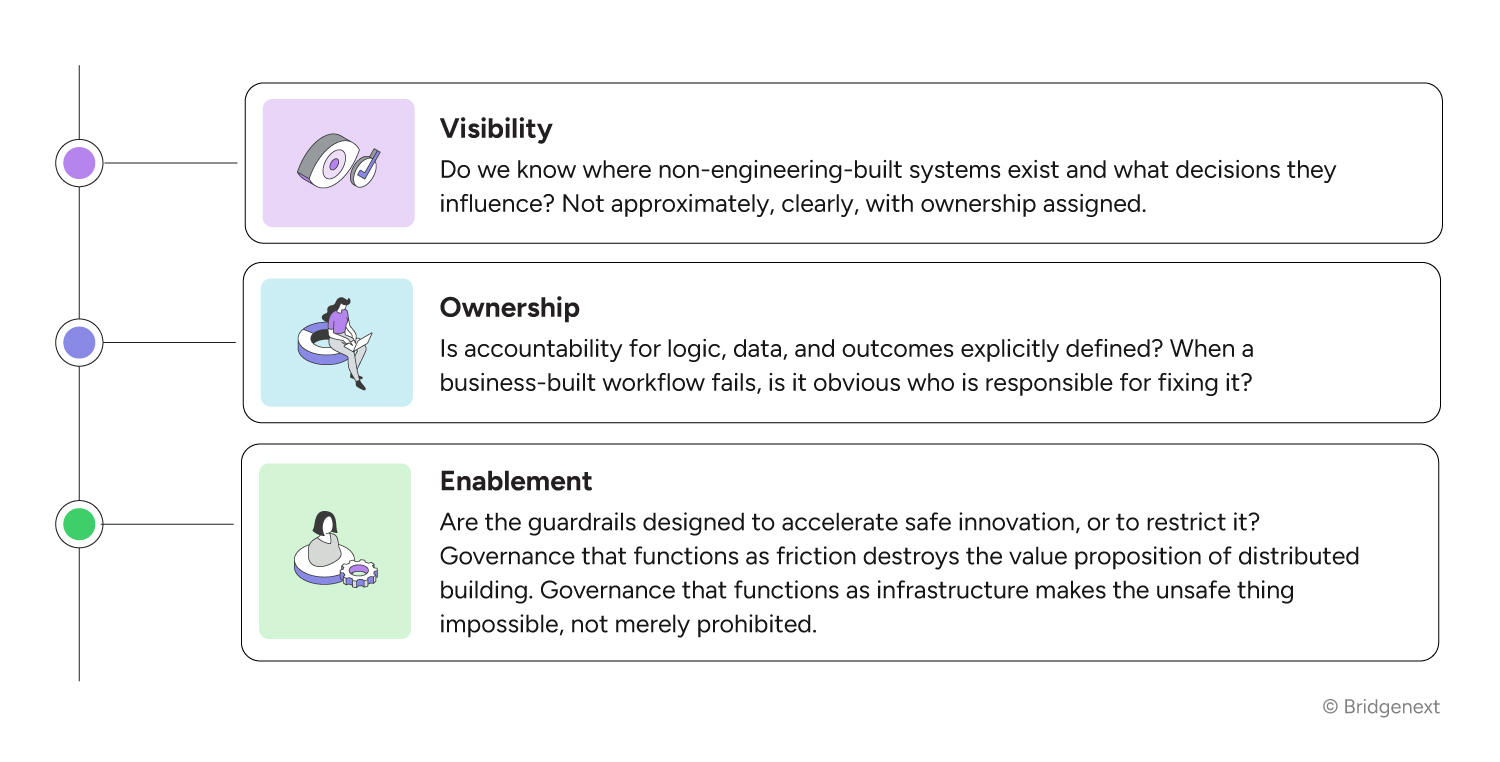
If any of these three answers is unclear, governance is already lagging. The goal is to design for participation at scale, giving more people the ability to build without sacrificing governance.
There’s a dimension of this challenge that doesn’t get enough attention in enterprise conversations about AI and low-code governance: institutional memory.
In a traditional engineering model, the organizational memory of why decisions were made lived in people: the architect who’d been on the platform for three years, the BA who knew why the data model was shaped the way it was. Fragile, but workable, while the same people stayed in the room.
AI-assisted building breaks that model entirely. Every session starts fresh. The coding agent has no awareness of the trade-offs that produced the current architecture unless that context is captured, maintained, and injected. Left unchecked, it makes choices that are locally rational and globally wrong, refactoring something that was structured deliberately, or contradicting a call made six months ago.
Most organizations have noticed this problem. The solutions that have emerged, however, are almost entirely individual. A developer maintains a personal markdown file that seeds their coding agent with project context. A team lead writes a system prompt that carries architectural guardrails into each session. An engineer keeps a running notes document they paste in at the start of every conversation. These approaches work, for that person, in that moment. But they are not governance. They are not auditable. They are not visible to the organization, transferable to a new team member, or defensible in a compliance review. When that developer leaves, the markdown file goes with them. When the team lead changes the system prompt, no one knows. The institutional memory problem hasn’t been solved; it has been pushed down to the individual level and made invisible.
This is the gap that separates organizations that are mastering AI-assisted development from those that are merely using it. Individual memory scaffolding is a workaround. Institutional memory infrastructure, governed, versioned, and accessible across every session and every contributor, is the operating model requirement. Without it, the speed of AI-assisted building doesn’t compound. It resets, every time, for everyone.
This is where documentation stops being overhead and becomes a first-class engineering artifact. Architecture decision records, policy files, and context documents are not bureaucratic compliance. They are the memory of every decision, and without them the speed advantage of AI-assisted building becomes a liability. The governed environment doesn’t just prevent bad outcomes. It supplies good judgment.
The enterprises that figure this out will build better, because the craft, the organizational knowledge, and the domain expertise that once lived in a handful of senior engineers will be present in every session, for every contributor.
Organizations that address the operating model proactively, rather than waiting for a governance failure to force the conversation, see measurable differences in outcomes:
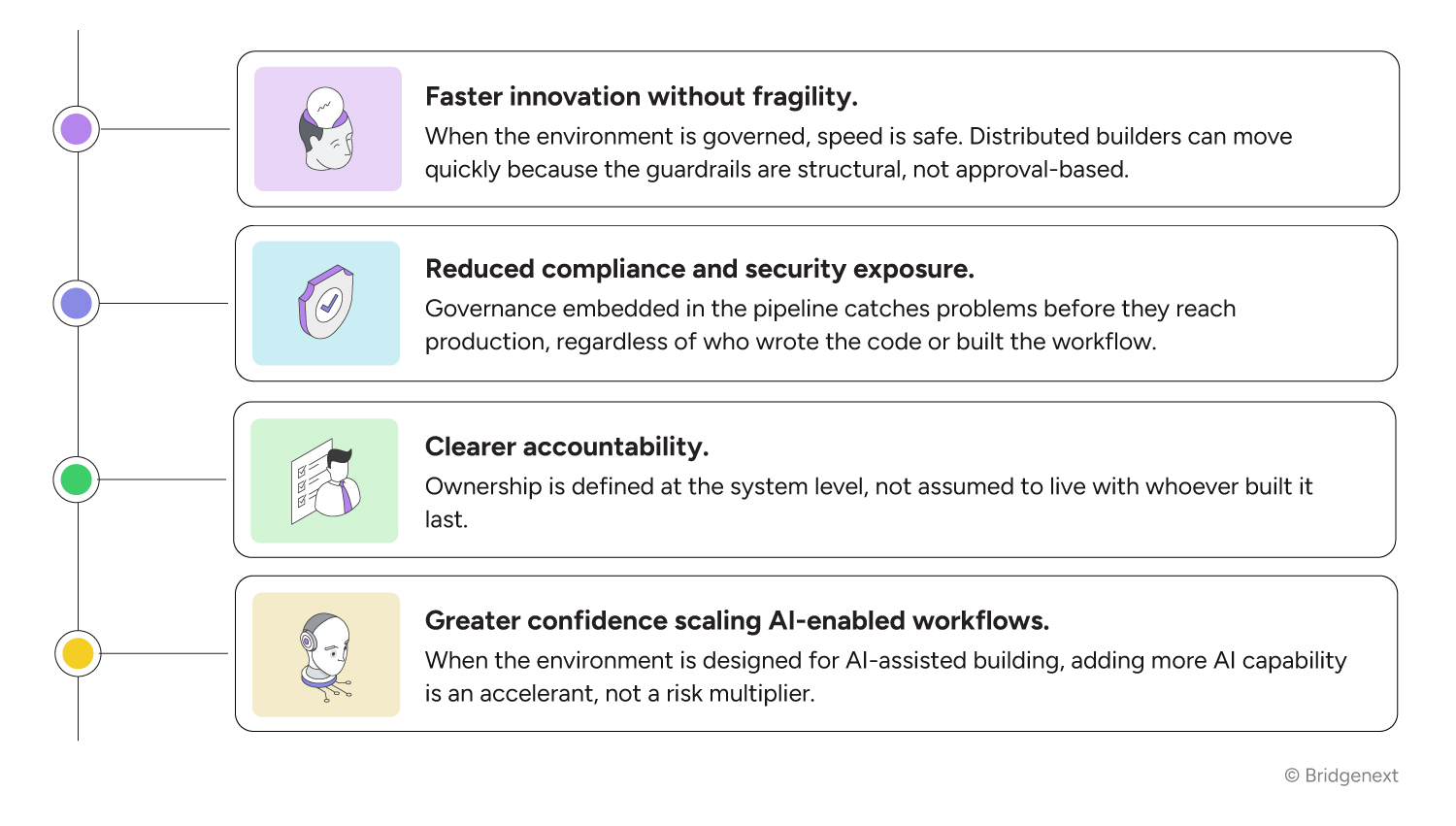
Bridgenext works with enterprise leaders to surface the reality of their distributed building environment, the applications that exist, the decisions they influence, the accountability gaps they’ve created, and to design operating models that solve it without re-centralizing delivery.
What that looks like in practice depends on the enterprise context. A product company running one complex long-lived platform needs a different governance structure than a portfolio enterprise managing dozens of applications, or a services organization assembling delivery workshops per engagement. The operating model design must fit the business, not the other way around.
Across all of them, the work is the same: align low-code, AI, data, and engineering into a coherent enterprise ecosystem with visible ownership, governed pipelines, and the institutional memory to sustain it. Innovation becomes intentional, scalable, and governable.
The distributed building problem did not begin with low-code, and it did not begin with AI. It began the moment someone built a business-critical process in a spreadsheet that only they understood, and the organization ran on it anyway. Low-code scaled that moment. It put the ability to build real software into the hands of people across the organization, and the governance models that existed were never redesigned to absorb it. What low-code exposed, AI has amplified, taking the same underlying challenge and accelerating it to proportions that the old responses can no longer answer. The scale, speed, and embeddedness are different, so the answer has to be different too. The leaders who act now gain visibility, resilience, and control while maintaining the speed that made distributed building attractive in the first place.
Low-code and AI are changing who builds. Make sure your operating model is ready.
Connect with our team to create the guardrails, accountability, and foundation your teams need to build and scale with confidence. Connect with us.
Related reading: This blog is a companion piece to Bridgenext CTO Dom Profico’s three-part series on agentic development and enterprise governance: “Vibe Coding Doesn’t Have a Quality Problem. You Do.” (Part 1), “The SDLC is a Relay Race. Software Should be Forged.” (Part 2), and “The Org Chart Is the Last Waterfall” (Part 3). It also relates to “The Vibe Coding Cleanup Bill: Why Companies are Paying Twice for the Same Product” by Pablo Romeo.