08.05.26 By Bridgenext Think Tank

Most insurance carriers have modernized their intake and layered in automation, yet claims still bottleneck, cycle times drag, and loss adjustment expenses stay stubbornly high. The gap between a functioning operation and a winning one isn’t a technology gap; it’s an intelligence gap, and it’s costing carriers market position every quarter.
Intelligent Document Processing (IDP) improves document intake accuracy, but it does not automatically reduce claims cycle time, lower loss adjustment expense (LAE), or drive straight-through processing (STP). True insurance claims transformation requires three connected layers: document intelligence, data intelligence, and decision intelligence, plus data readiness and workflow orchestration before any automation program can scale.
Intelligent Document Processing (IDP) uses AI, OCR, and machine learning to classify, extract, and validate data from unstructured insurance documents, PDFs, handwritten FNOL forms, medical records, police reports, and adjuster notes. Insurers invested heavily in IDP, expecting it to solve the unstructured data crisis: roughly 97% of claims-relevant information exists outside structured systems.
The prolem: IDP was designed to read documents. What carriers needed was a system that acts on them.
When automation absorbs document intake, something revealing happens. Exception rates don’t fall the way projections said they would. Adjusters are still manually reconciling data across systems. Cycle times improve at intake and stagnate everywhere else, leaving dozens of use cases in isolated functions, none of them rewiring the operation. The bottleneck didn’t disappear. It relocated downstream, into governance, data validation, and workflow handoffs.
Understanding where your organization sits in the industry’s adoption curve is the first step to closing the gap.
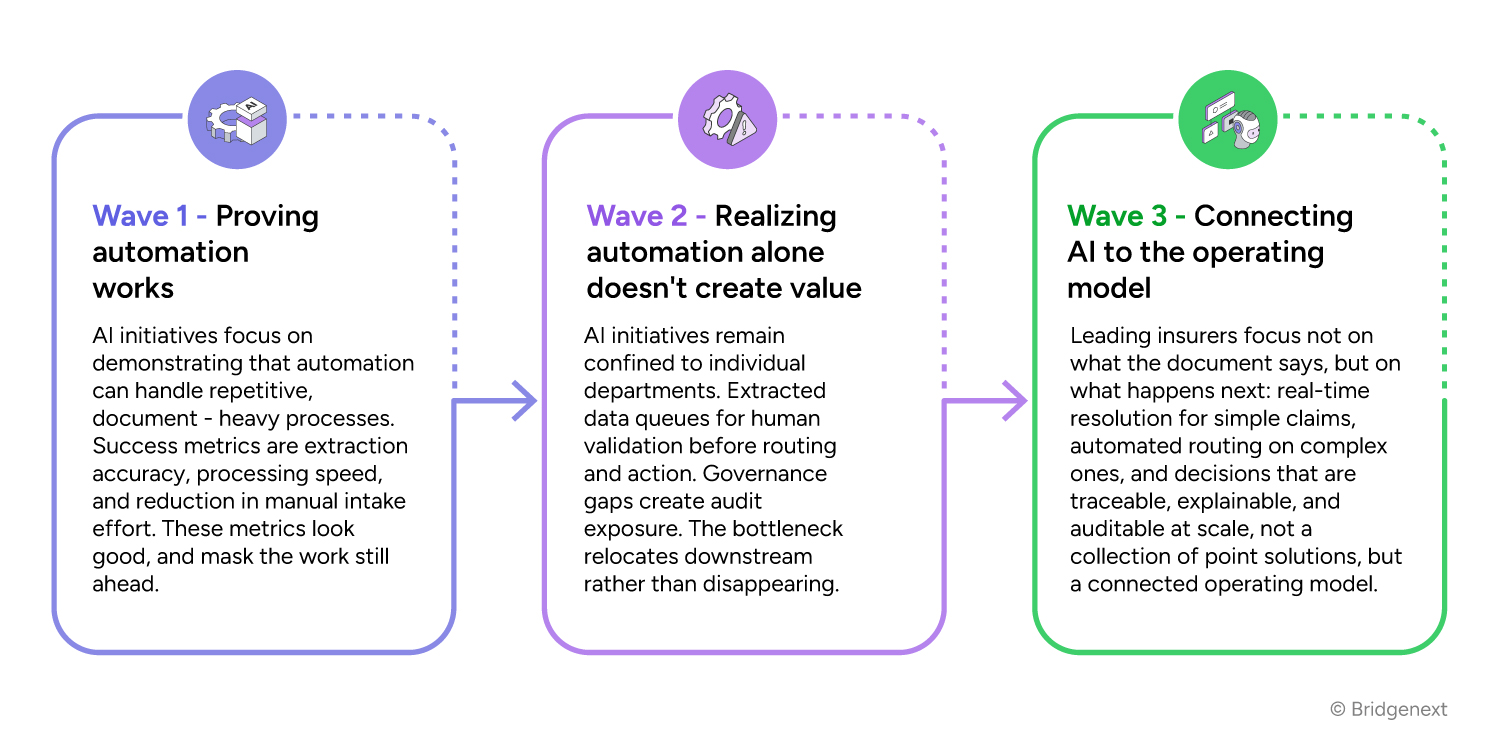
Carriers who reach Wave 3 are not just more efficient; they are structurally harder to compete against. Faster cycle times reduce loss adjustment expense. Higher straight-through processing rates free adjusters for complex, high-value cases. Explainable AI shifts the regulator conversation from “can we use this?” to “here’s how it performs.” Building that connected operating model is exactly what a mature enterprise-wide automation strategy requires.
The shift from Wave 2 to Wave 3 requires moving beyond document extraction to a three-layer operating model:
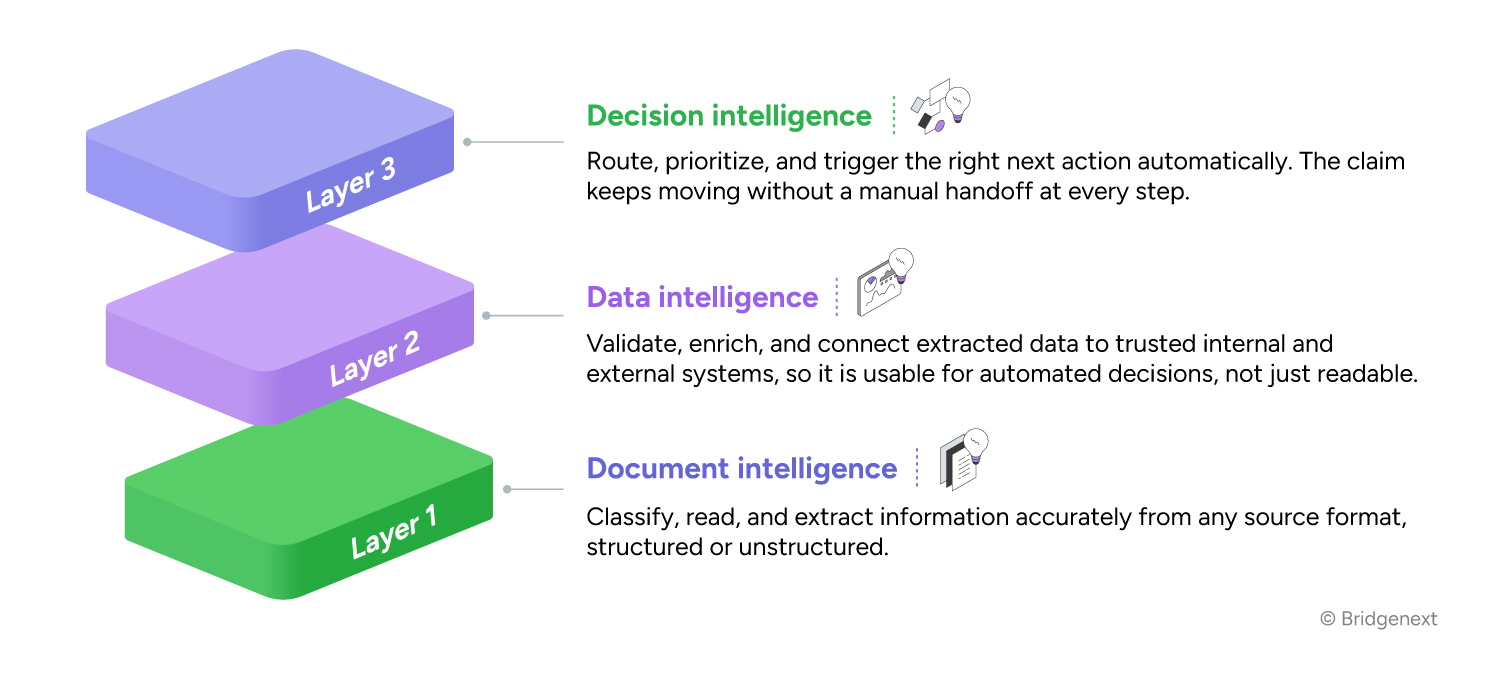
Most IDP programs delivered Layer 1. The enterprise value, i.e., reduced LAE, improved STP rates, and shorter claims cycle time, lives in Layers 2 and 3, and closing that gap is precisely what intelligent process automation is designed to do. That is where most investments have not gone yet.
Before expanding any claims automation initiative, assess your program across five dimensions. The readiness model below shows how these connect, and where most carriers discover their gaps.
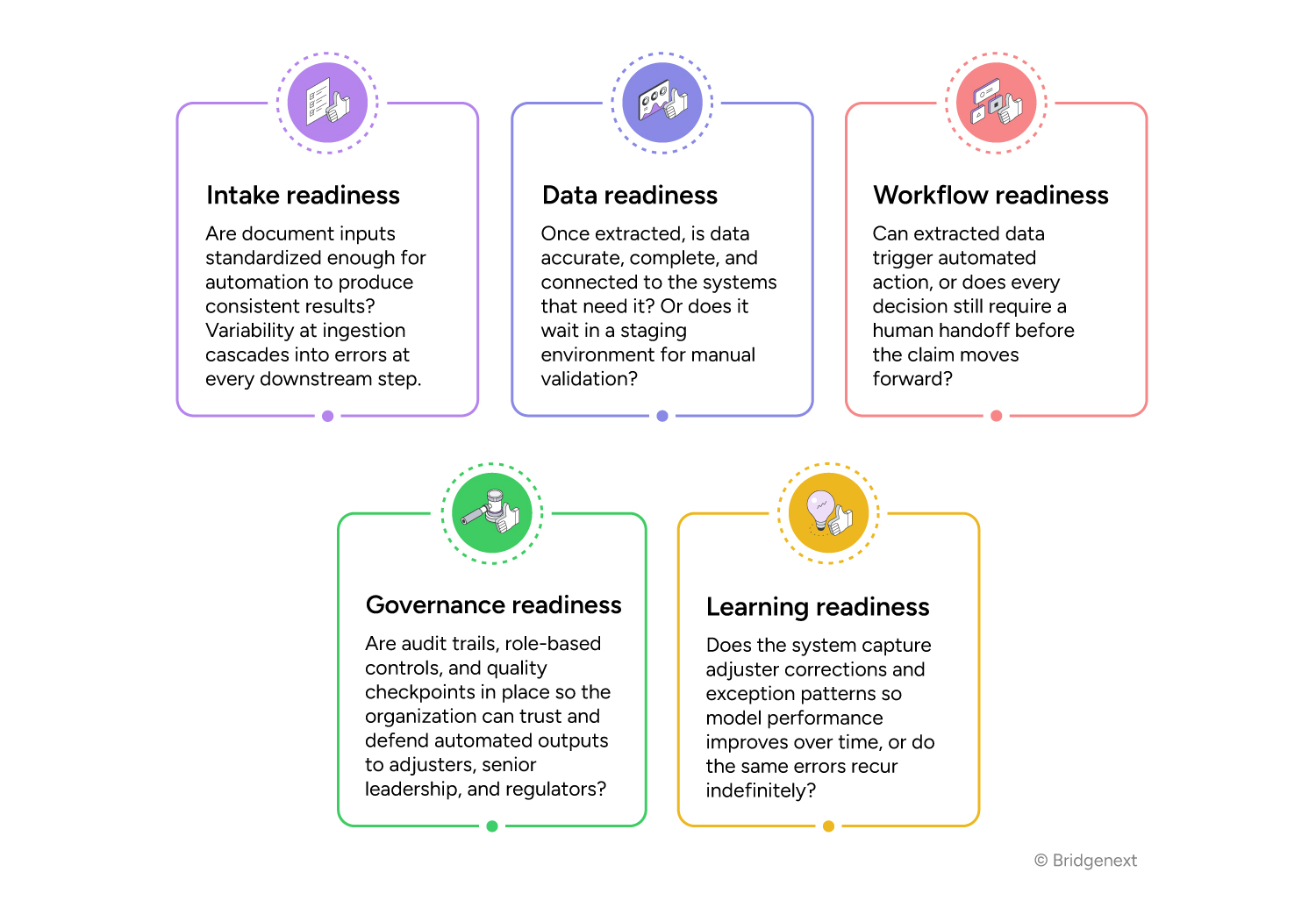
What carriers typically find: Intake readiness is reasonably strong. Data readiness, workflow readiness, and learing readiness are the consistent gaps, and the consistent reason automation programs plateau.
Research on modern IDP-driven claims automation shows efficiency improvements of up to 90% at the document intake stage. But the enterprise outcomes that decision-makers actually care about come from connecting all three layers:
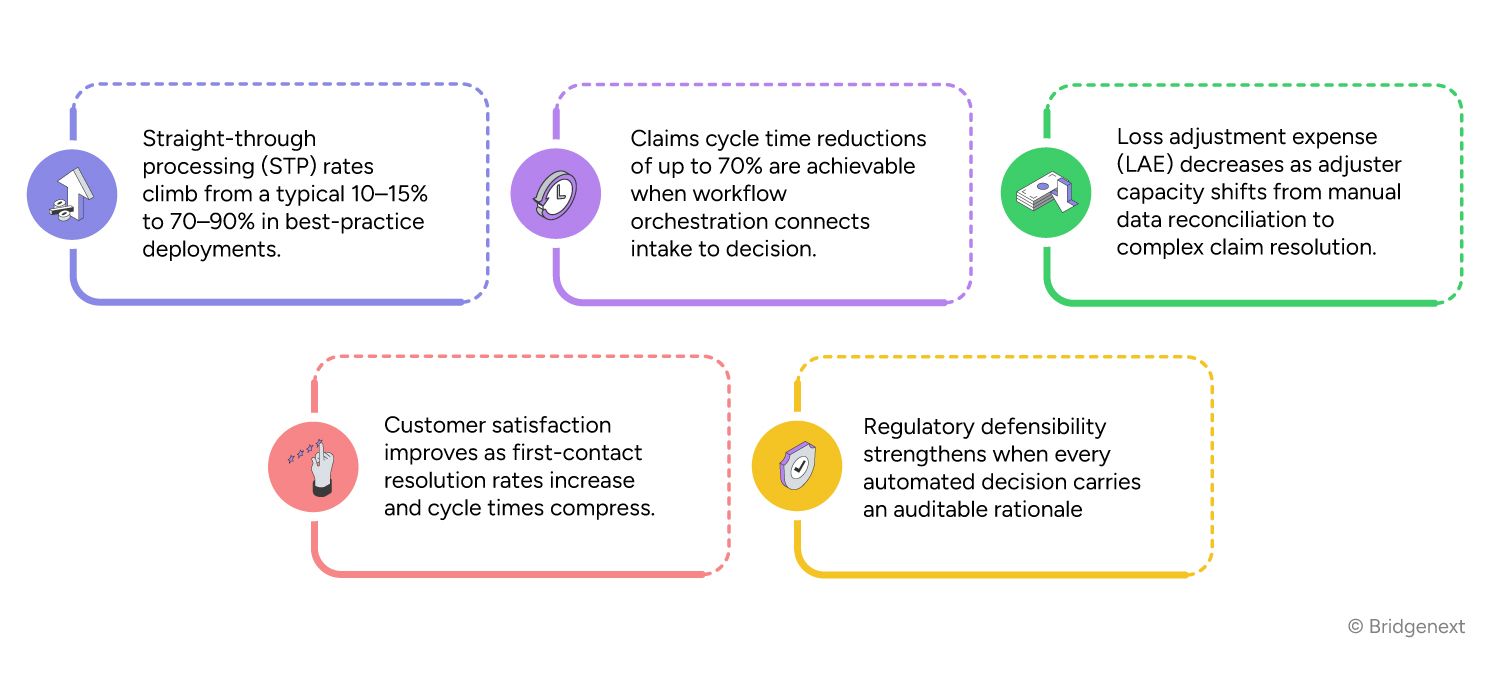
Forrester projected $6.5 billion in annual industry savings from AI-driven claims automation, but only for programs that reach the workflow and decision intelligence layers, not for IDP deployed in isolation. For carriers already absorbing combined ratios above 112% in personal auto and catastrophe losses exceeding $100 billion, that distinction is the difference between a pilot and a business imperative.
The three barriers that most consistently prevent insurers from moving beyond pilot programs:
Extracted claims data cannot trigger downstream automation if it sits in disconnected systems or requires manual transformation before it reaches policy admin or claims management platforms. Data readiness, not model accuracy, is the binding constraint.
IDP outputs land in a queue. A human reviews, validates, and routes. The automation created a faster queue, not a connected workflow. Without orchestration, straight-through processing rates remain low regardless of extraction quality.
Insurers operating in regulated environments cannot scale automated claims decisions without audit trails and explainable outputs. When governance infrastructure lags behind model deployment, the legal and compliance risk forces human checkpoints back into the process, eliminating the efficiency gains.
The carriers building durable competitive advantage in claims operations share a consistent set of practices:
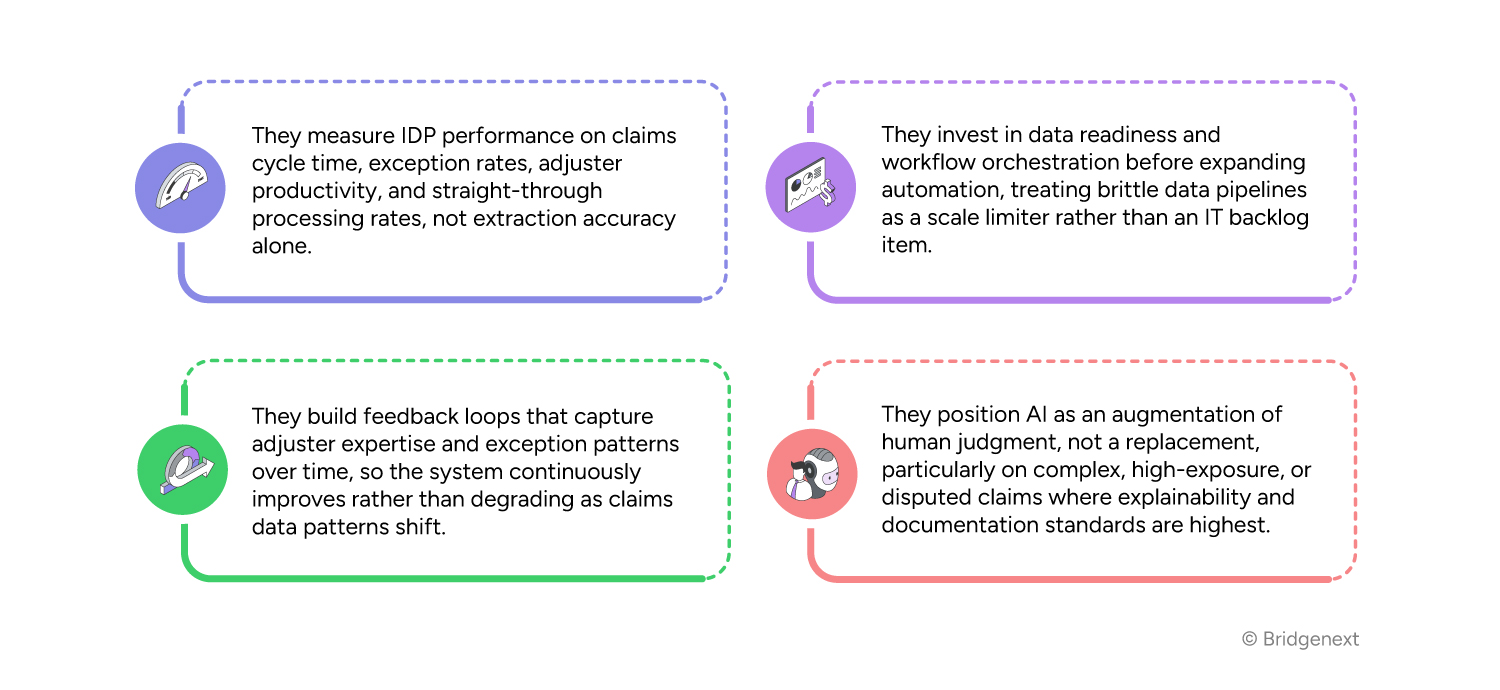
The result is a claims ecosystem where data flows from intake to decision to action without friction, and where every automated output is traceable. Speed, accuracy, and accountability together are what convert AI investment into a defensible operational advantage. See how Bridgenext approaches this end-to-end in our insurance transformation practice.
For every year a carrier runs isolated AI pilots without connecting them to end-to-end workflow, a competitor who has made that connection compounds the gap. This pressure isn’t limited to claims operations; it’s part of the broader digital transformation imperative facing every part of the insurance business, from brokerages to carriers. Cycle time advantages translate to customer retention. LAE reductions compound into margin. Governance capability opens regulator conversations that peers cannot yet have. IDP was the right first step. The next step is making it move the entire claims operation. The winners will be those who connect document intelligence, data intelligence, and decision intelligence into a unified operating model that continuously learns and improves, ultimately helping the organization create competitive advantage/unlock growth.
Getting there requires a partner who understands both the technology and the operational model it has to serve. Bridgenext works with insurers at each layer of that journey, from data readiness and workflow orchestration to governance infrastructure and continuous learning, translating AI investment into measurable claims outcomes rather than perpetual pilots.
If your IDP program has plateaued, the gap is rarely in the model. It’s in what surrounds it. That’s exactly where we start.
Talk to our claims modernization team →
IDP (Intelligent Document Processing) automates the extraction and classification of data from unstructured insurance documents. Some carriers extend this with AI copilots that surface extracted insights directly to underwriters and adjusters, a combination explored in depth in our guide to enhancing insurance operations with IDP and Copilots. Claims workflow orchestration connects that extracted data to downstream systems and automated decision logic so the claim moves forward without manual handoffs. IDP is an input layer; workflow orchestration is the operating layer that delivers enterprise-wide claims transformation.
Most pilots automate document intake without addressing what comes after: data validation, system integration, and governance. When extracted data can’t flow into policy administration or claims management systems without manual intervention, the result is a faster intake queue, not a connected claims operation.
STP refers to claims assessed, validated, and resolved entirely by automated systems, with no manual adjuster intervention. Leading deployments achieve 70–90% STP rates on simple claim types. The industry average without connected workflow automation sits at 10–15%.
Data readiness is how accurately, completely, and consistently extracted claims data flows into every system that needs to act on it. Fragmented platforms, inconsistent source documents, and weak data governance are the most common reasons IDP programs stall after intake without improving downstream outcomes.
Higher STP rates and shorter cycle times mean fewer manual touchpoints per claim, and LAE falls accordingly. The compounding effect matters: as automation scales across claim volumes, the per-claim cost reduction accumulates into a measurable margin advantage.
Every automated routing or coverage decision needs a documented rationale that adjusters, compliance teams, and regulators can audit. Without it, insurers can’t defend automated outputs in litigation or regulatory review, and human checkpoints get reinserted, which negates the efficiency gains.
References:
www.mckinsey.com/industries/financial-services/our-insights/the-future-of-ai-in-the-insurance-industry
www.allaboutai.com/resources/ai-statistics/ai-in-insurance/
www.insurancebusinessmag.com/us/news/technology/carriers-stuck-in-pilot-purgatory-as-ai-fails-to-graduate–sedgwick-567339.aspx
www.insurancethoughtleadership.com/ai-machine-learning/ai-insurance-2026-advantages-and-challenges
riskandinsurance.com/traditional-insurance-leaves-enterprises-exposed-as-ai-liability-claims-surge/
www.waterstreetcompany.com/ai-hallucination-in-insurance-what-pc-insurers-should-know/
www.deloitte.com/us/en/insights/industry/financial-services/financial-services-industry-outlooks/insurance-industry-outlook.html