08.13.25 By Bridgenext Think Tank

What a war-room conversation about inflation taught us about design thinking in logistics. “When fuel prices shoot up overnight and our carrier network is in chaos, why are we still relying on last year’s playbook?” a supply chain leader asked this during a strategy session in Q1 2025. The room fell quiet. Not because there wasn’t an answer, but because the right answer meant unlearning everything “standard” about logistics innovation.
That’s why nowadays transportation and logistics (T&L) leaders aren’t just looking for transformation. They’re looking for relevance. And that requires more than implementing AI or automation. It calls for a mindset shift, one that brings users to the center of innovation.
Before we talk solutions, let’s acknowledge the elephant in the room: most T&L ecosystems are overwhelmed by fragmented systems, aging infrastructure, and disconnected processes. Layering new tech over old workflows only adds complexity.
What’s needed is a more thoughtful approach, one that balances speed with substance, and strategy with empathy. That’s where design thinking comes in. An approach delivers business impact, without demanding a complete teardown of what already works.
Design thinking isn’t new, but its application in logistics has evolved. No longer a creative exercise confined to product teams, it’s becoming a discipline for business transformation, rooted in listening, iteration, and alignment.
Here’s how we’ve seen it work in practice:
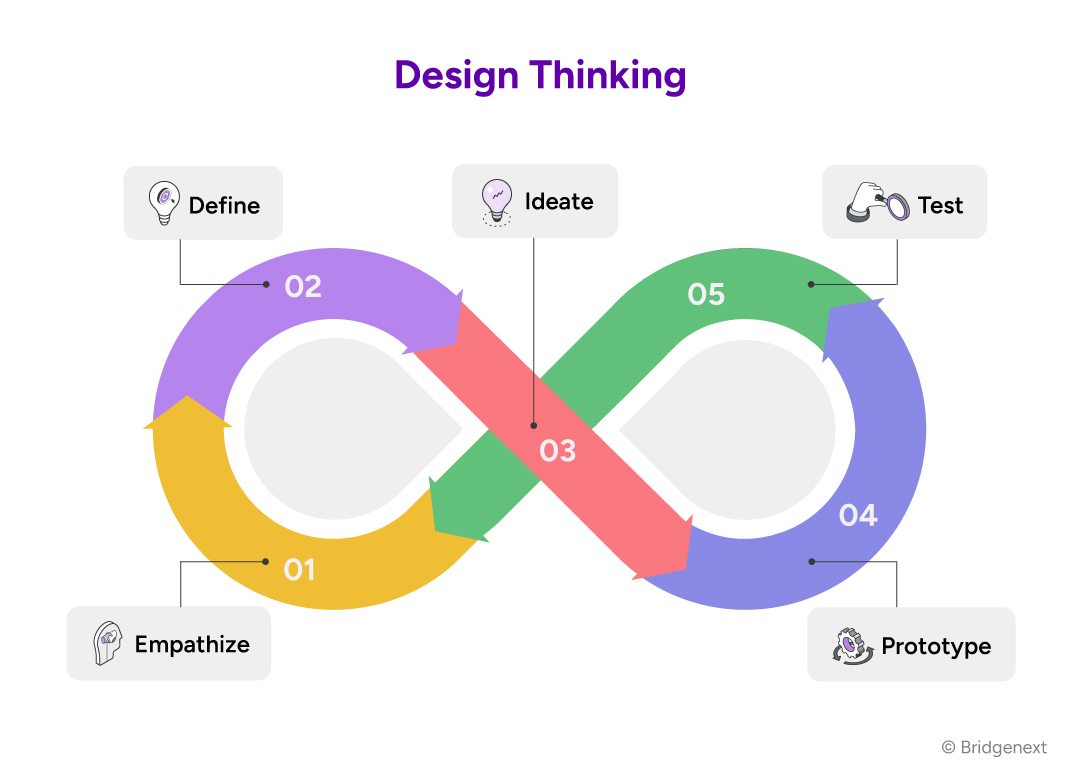
Innovation begins with understanding people, not building products. In transportation and logistics (T&L), where teams juggle multiple disconnected systems, empathy becomes essential. While developing an AI-based conversational bot, we engaged directly with users. What we discovered was telling, people were wasting time switching between apps just to complete basic tasks. What they truly needed was a single-window interface that simplified operations. Empathy meant more than identifying pain points, it meant seeing through the user’s lens to create meaningful change.
With insights in hand, the next step is defining the real challenge. The issue wasn’t just multiple systems, it was the inefficiency and user frustration caused by fragmentation. By reframing the problem around user experience and productivity, we aligned innovation with what actually matters to the business and its people.
With a clear problem in focus, we moved into ideation – inviting diverse voices to the table. Over six months, we explored what it would take for the bot to feel intuitive and human. The answer: it must understand natural language, speak logistics fluently, and integrate seamlessly into daily workflows. Creativity grounded in user need led to bold, practical solutions.
We quickly moved from ideas to prototypes – mockups and working models tested by real users. Early feedback helped us validate what worked and revise what didn’t. The goal wasn’t perfection, but progress. Each iteration brought us closer to a solution users would actually embrace.
Testing turned feedback into fuel. We released the prototype to actual T&L users and carefully analyzed how it performed. Refinements followed. Features were sharpened, friction points removed. It was less about finalizing a product and more about evolving one, grounded in what users actually need. Design thinking isn’t a linear process, it’s a mindset. And it helped us transform scattered ideas into a focused, user-validated solution.
Design thinking complements, not replaces, technical innovation. It ensures that technologies like AI, UAVs, and data unification deliver usable value. Here’s how it’s showing up across key 2025 industry shifts:
| Strategic Trend | What Leaders Are Prioritizing |
|---|---|
| AI, done responsibly | Leaders are deploying Agentic AI that aligns with compliance, reduces rework, and improves decision accuracy, without overwhelming teams. |
| Sustainability through optimization | Data Analytics led route intelligence, load planning, and predictive maintenance are directly cutting emissions and fuel costs. |
| UAVs, sensors, and automated mobility | Logistics networks are experimenting with drone-assisted final-mile, and robotic process automation. |
| 360° data visibility | Leading firms are unifying structured and unstructured data, gaining visibility across customer commitments, asset uptime, and cost-to-serve. |
These aren’t aspirational trends, they’re being built today by teams who put design thinking and generative AI solutions into action.
When innovation is siloed, tucked into labs or explored without business context, it struggles to scale. When is it grounded in user needs, driven by iterative design, and aligned to measurable value? That’s when transformation sticks. Design thinking gives leaders a proven, structured way to get there, without falling into the “tech for tech’s sake” trap.
At Bridgenext, we believe innovation isn’t about pushing the latest technology. It’s about solving the right problems with clarity, empathy, and purpose.
Design thinking is core to how we help T&L organizations innovate. We work closely with you to understand your challenges, whether you’re managing fragmented systems, facing operational inefficiencies, or exploring AI for the first time. We treat your problems like our own and co-create solutions that are intuitive, scalable, and aligned to business goals.
We’re proud to be the preferred innovation partner for both emerging and established transportation and logistics firms. We won’t push you to follow trends or adopt what everyone else is doing, we’ll guide you toward what’s right for you.
Because great innovation doesn’t follow the crowd it leads with understanding. Contact us to start a conversation.