02.13.26 By Dominick Profico

Agentic AI’s promise is bold and disruptive: autonomous agents capable of planning, deciding, and acting across systems, without human intervention. Unlike traditional automation or AI-assisted workflows that rely on predefined rules and linear processes, agentic systems introduce adaptive, end-to-end decision-making and execution. Through multi-agent orchestration, these systems can self-organize, continuously learn, and adjust their actions to changing contexts, much like high-performing teams that coordinate, adapt, and optimize outcomes without constant direction. This shift enables not just efficiency gains but a new level of operational resilience and innovation.
For enterprises, the excitement is palpable, and for good reason. Early adopters are already showcasing agents that forecast demand, triage customer issues, optimize pricing, and recommend the next best actions. These use cases demonstrate the potential to redefine business operations and customer experiences. However, while the momentum is undeniable, scaling agentic AI into production-grade, business-critical systems remains a significant hurdle for most organizations.
According to IDC, the challenge isn’t the lack of intelligent agents; it’s the complexity of orchestrating them across enterprise data, cloud infrastructure, and platforms. Organizations that want to take advantage of the technology are missing the robust foundations needed to deploy it safely, reliably, and at scale.
Many enterprises are achieving strong results by introducing autonomous capabilities into targeted areas of the business, validating value, enhancing responsiveness, and uncovering efficiency.
At this initial stage, agentic systems typically operate within well-defined boundaries. Data inputs are curated and predictable, workflows are structured, and oversight models ensure confidence in outcomes. These controlled conditions are ideal for building trust and proving feasibility.
However, as organizations aim to scale agentic AI across the enterprise, the operating context becomes significantly more complex.
At scale, autonomous systems must process continuously changing data, coordinate actions across interconnected platforms, and perform reliably in dynamic production environments. This evolution places new demands on the underlying data architecture, cloud platforms, and governance frameworks. Challenges such as latency, data fragmentation, and policy misalignment, manageable through manual manipulation in pilot phases, become critical obstacles when decisions must be made and executed in real-time.
Industry research underscores this reality. IDC highlights that the long-term success of agentic AI relies less on algorithmic sophistication and more on the enterprise’s ability to orchestrate agents within a cohesive, production-ready ecosystem. When platforms, data flows, and governance evolve in unison, agentic systems can transition from supporting decision-makers to achieving sustained autonomy. Scaling agentic AI is not about adding more intelligence; it’s about aligning foundational capabilities, data, cloud, and platform architecture, with the strategic intent to operate faster, smarter, and with greater resilience.
As organizations embrace autonomy, data quality evolves from a technical issue to a critical business risk. In traditional systems, poor data results in flawed insights. In agentic systems, poor data drives flawed actions, executed at machine speed and scale. Inconsistent records, outdated documents, or ungoverned data sources can trigger cascading errors across interconnected systems in seconds. Pricing inaccuracies, unauthorized approvals, or compliance breaches are no longer isolated incidents; they become systemic risks, amplified by automation.
This is why data quality, document integrity, lineage, and validation are non-negotiable in agentic environments. The adage “garbage in, garbage out” takes on heightened significance when AI is empowered to act autonomously rather than merely provide recommendations. IDC underscores this risk, warning that poorly governed agentic systems can lead to immediate and severe consequences, including operational disruptions and a loss of executive trust. Governance, therefore, is not an afterthought; it is the bedrock of successful autonomy.
While industry research highlights the importance of data, cloud, and orchestration in scaling agentic AI, Bridgenext’s experience shows that these capabilities only become differentiators when they are engineered together, not treated as standalone initiatives. The fundamental challenge is building these foundations in a way that supports autonomous decision-making at enterprise scale.
Agentic systems don’t just require faster data; they need better data foundations. Autonomous decision-making depends on timely signals such as pricing changes, inventory movements, customer behavior, and operational status, but speed alone is insufficient. What matters equally is data quality, semantic consistency, and the ability to combine structured and unstructured data at scale to provide agents with full contextual awareness.
Batch updates and siloed datasets limit agents to partial or outdated views of reality, causing hesitation or suboptimal decisions. This is not a shortcoming of AI models, but a reflection of incomplete data architecture. To scale agentic AI, enterprises must move beyond static, fragmented data toward architectures that support real-time availability, rich semantic modeling, high-quality governance, and diverse data sources, creating a foundation in which agents can reason, adapt, and act with confidence.
Deploying agents within isolated applications creates pockets of localized intelligence, but it limits their ability to drive meaningful outcomes. True autonomy requires agents to act across interconnected systems, ERP, CRM, supply chain, finance, and operations, via APIs and event-driven platforms. Without orchestration, agents are reduced to passive observers, identifying problems but unable to resolve them. Enterprises must invest in platform-level integration to enable seamless coordination and execution.
Traditional systems are designed to react: detect an issue, notify a human, and wait for action. Agentic systems, however, are designed to act: anticipate challenges, evaluate options, execute decisions, and escalate only when confidence thresholds are breached. Without this shift, AI remains an analytical tool rather than a true execution engine. Enterprises must reimagine workflows to empower agents to move from insight to action autonomously.
High-quality data is essential, but agentic AI cannot scale without a resilient platform foundation. What’s often overlooked is that many of the architectural principles required to support agentic systems are not new. The same cloud-native patterns that enabled scalability, reliability, and speed over the past five years have become even more critical as enterprises move toward autonomous decision-making.
Agentic systems operate continuously, generating events, coordinating actions, triggering workflows, and adapting in real time. Supporting this level of autonomy requires platforms that were designed for change, not just efficiency. In practice, this means enterprises need:
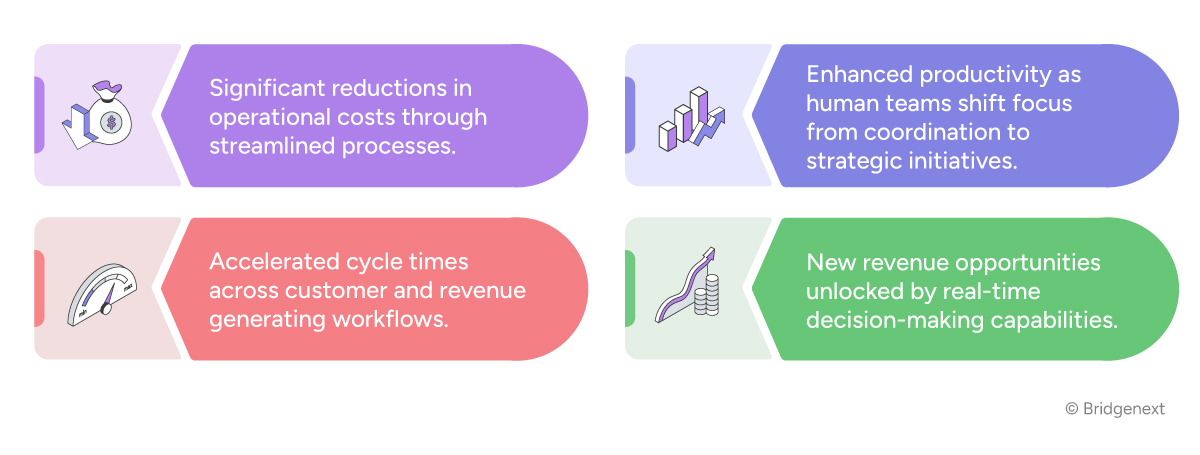
These are not emerging best practices; they are proven architectural foundations. What has accelerated is the cost associated with getting them wrong. Without them, agentic systems are constrained by latency, brittle integrations, and manual intervention points. The result is not true autonomy, but fragmented execution and increased operational risk.
For enterprises, platform readiness is the difference between agents remaining isolated experiments and becoming trusted, scalable participants in everyday operations. The lessons learned from building resilient cloud platforms over the last decade are now the very enablers of the autonomous systems of the future.
When data, cloud, and platform foundations are aligned, agentic AI transitions seamlessly from potential to profit. According to McKinsey, autonomous agents can compress days of sequential work into mere hours by executing tasks in parallel and adapting in real time. Organizations that have successfully deployed agentic systems in production report:
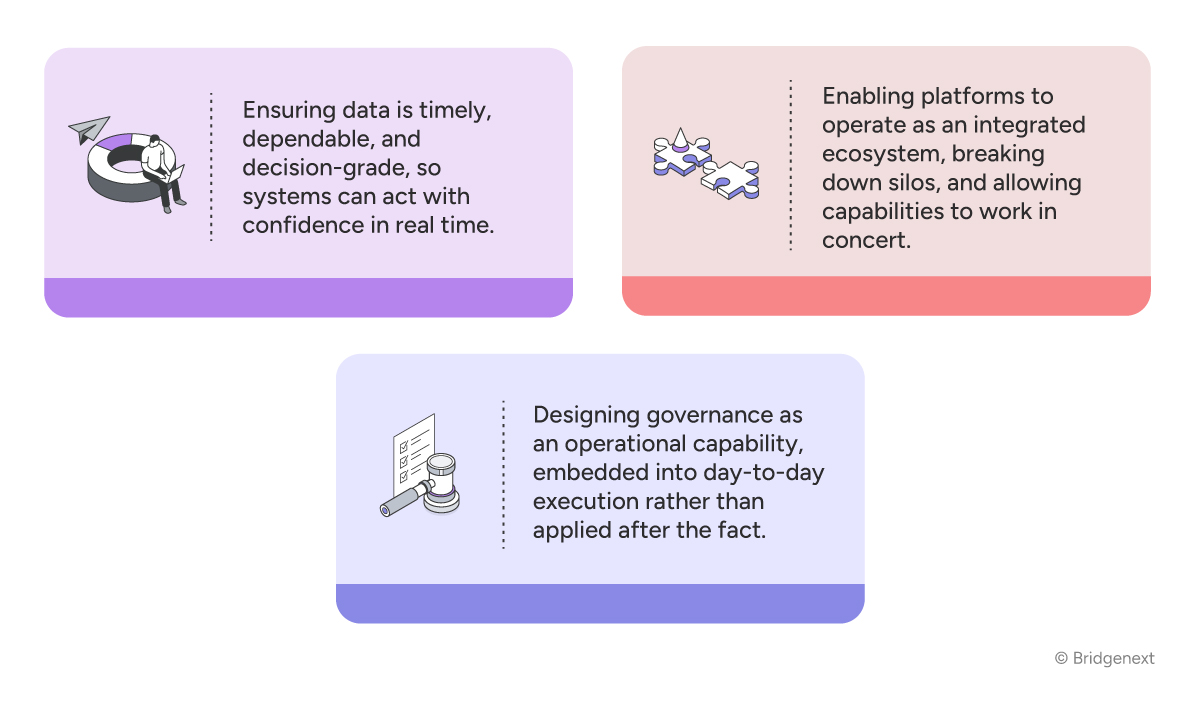
These transformative outcomes are not solely the result of advanced AI models. They stem from environments purpose-built for autonomy, where data flows dynamically, platforms integrate seamlessly, and systems scale effortlessly.
For enterprises, the message is clear: the foundation is not just a technical prerequisite, it’s a strategic enabler of competitive advantage.
Organizations making meaningful progress aren’t immediately chasing wholesale transformation. They’re being deliberate. They begin by strengthening the foundations of workflows where speed, coordination, and decision latency have a direct impact on revenue, costs, or customer experience. These high-impact areas provide clear returns and build confidence in the potential of autonomy.
This focus is not just about deploying AI agents; it’s about building autonomy readiness across the enterprise. Agentic AI is one of the most visible ways organizations are pursuing autonomy today, but the same principles apply across all automation and intelligent decisioning initiatives. Whether driven by agents, workflows, or hybrid human-machine systems, autonomy succeeds only when these foundational priorities are in place:
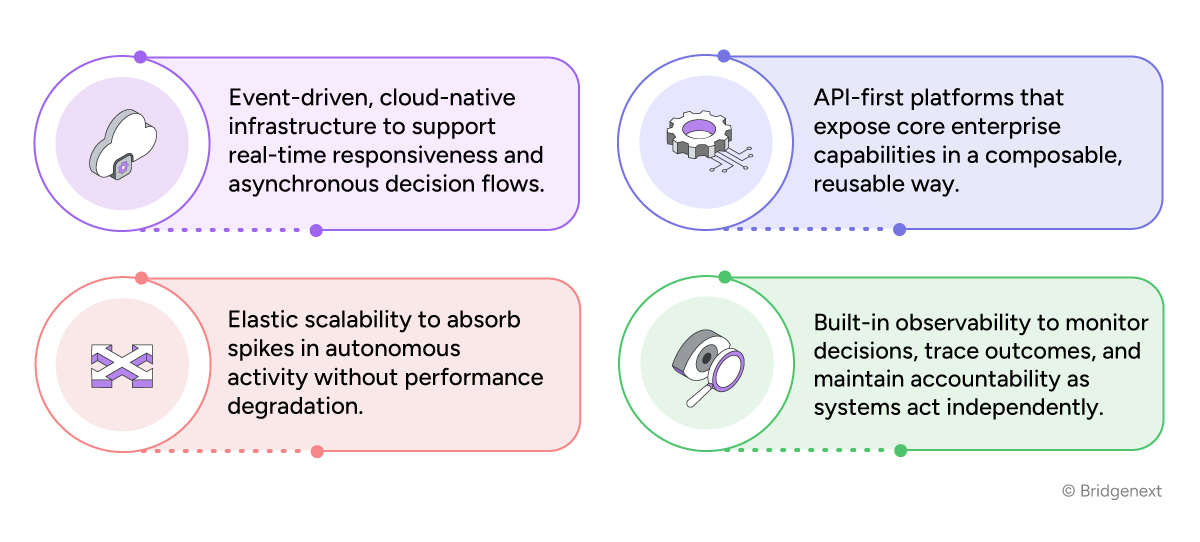
When these elements are aligned, agents and automation more broadly move beyond analysis into execution with clarity, control, and resilience.
Leading enterprises also recognize that agentic AI is not merely a system-level upgrade. Technology is only one part of the equation. Sustained value comes from aligning platforms, operating models, processes, change management, and decision ownership so autonomy can scale without introducing friction or risk.
This is where Bridgenext helps organizations realize value from their digital investments by applying the right technology, at the right time, in the right way. By grounding AI and automation initiatives in strong data foundations, scalable platforms, and pragmatic governance, Bridgenext enables enterprises to turn experimentation into execution and autonomy into measurable business outcomes.
Unsure if your data and platforms are ready for agentic AI? Connect with our team to get guidance on actionable next steps.
References
my.idc.com/getdoc.jsp?containerId=prUS53883425#:~:text=Spanning%20more%20than%2035%20worldwide%20reports%2C%20IDC%E2%80%99s%20FutureScape,competitiveness%20across%20every%20sector%20of%20the%20global%20economy
www.businessinsider.com/agentic-internet-ai-rails-google-anthropic-openai-2025-9
www.businessinsider.com/sc/harness-agentic-ai-with-dynamic-orchestrated-data-essential-changes-for-success
www.techradar.com/pro/garbage-in-agentic-out-why-data-and-document-quality-is-critical-to-autonomous-ais-success