07.23.25 By Bridgenext Think Tank

Not just another AI pitch—real operational impact, where it matters most.
Walk into any busy logistics operation; a freight forwarding office, a 3PL warehouse, or a freight dock, and you’ll likely see a mix of real-time dashboards, legacy systems, and something that refuses to go away: documents.
They’re on desks, in shared drives, attached to emails, and printed in triplicate. Invoices. Bills of lading. Customs documents. Proof of delivery (PODs). Contracts. Warehouse receipts and more. Despite major strides in digitization, many still operate on paperwork, and it is one of the most underestimated sources of inefficiency in transportation and logistics today.
Now, here’s the catch – the systems aren’t broken. Most Transportation & Logistics companies have already invested in an ERP, TMS platforms, WMS tools, CRM and other customer portals. But between these systems lies a gap, a lack of integration and a human bottleneck in processing and validating documents.
That’s not a tech problem. That’s an efficiency gap, and it’s exactly what we’re here to close.
Let’s take a simple shipment. It typically comes with 4 to 6 supporting documents. Each one needs to be reviewed, verified, categorized, and sometimes even translated, just to move the freight. Multiply that by hundreds or thousands of shipments a week, and you’re looking at a hidden operational cost that affects:
And while logistics today demands real-time execution, your people are still sifting through PDFs, spreadsheets and even handwritten documents.
Intelligent Document Processing (IDP) is not new. But what’s changed dramatically in the last two years is how much more powerful, adaptable, and precise it has become, thanks to the maturity of Generative AI and Large Language Models (LLMs).
Traditional IDP systems could extract fields and process templates. But when it came to nuance, interpreting handwritten notes, understanding clause variations in contracts, or classifying ambiguous forms, they struggled.
Now, with LLMs in the loop, IDP systems are not just rule-based processors. They’re context-aware, language-capable, and continuously improving engines that understand meaning, resolve ambiguity, and generate structured, usable data from even the most unstructured content.
With Generative AI in the loop, IDP becomes a cognitive layer that makes sense of ambiguity, translates context into action, and extracts structured insights from even the most complex or messy document formats.
This is not a glimpse into the future, it’s live, tested, and already transforming how logistics leaders operate.
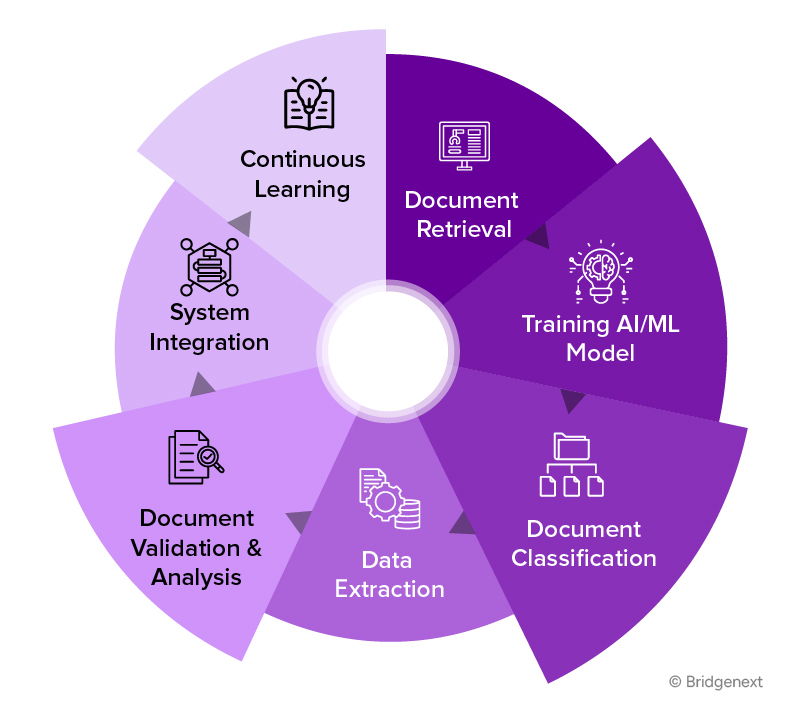
Here’s how a modern IDP system, powered by Generative AI solutions, typically works:
| Use Case | Description |
|---|---|
| 1. Shipping Documentation | Speed up processing of packing slips, delivery notes, and shipment manifests with near-zero errors. |
| 2. Contract Intelligence | Use LLMs to extract SLAs, rate conditions, and penalty clauses from complex contracts and make them searchable and actionable. |
| 3. Proof of Delivery & BOL | Extract consignee details, delivery times, and signature verification without manual entry, with real-time insights for customer portals. |
| 4. Customs Compliance | Validate product details, HS codes, and declaration line items to minimize risk of non-compliance or shipment delays. |
| 5. Carrier Billing Audits | Check invoices against contracted rates instantly, catching overcharges and reducing reconciliation time. |
| 6. Warehouse & Inventory Reports | Digitize and structure handwritten or scanned reports into live inventory updates. |
| 7. Fleet & Regulatory Docs | Automate tracking and renewal reminders for driver licenses, permits, inspection records, and more. |
Generative AI is already reshaping how businesses operate, compete, and deliver value, especially in industries as complex and time-sensitive as logistics.
In the next few years, every operational layer, from documentation and routing to billing, compliance, and customer service, will have an AI layer built in. Not because it’s “innovative,” but because it’s simply more efficient, more accurate, and more scalable.
And here’s the reality most don’t want to admit: If you’re not offering these capabilities to your customers, someone else will.
Even long-standing customers won’t wait. They need faster turnarounds, fewer errors, and better visibility. If someone else can deliver that with Generative AI solutions, they’ll switch. Not because they want to, but because they have to.
IDP addresses this head-on. It removes the need for human intervention in low-value tasks and enables decisions to be made with near real-time accuracy and clarity.
We’re not in the business of pushing Generative AI for trend’s sake. At Bridgenext, we specialize in closing operational gaps, the kind that fall between good systems and great performance.
We’ve helped freight brokers, 3PLs, and global shippers automate what they thought couldn’t be automated. Our approach is grounded in your business reality, not a lab demo.
Whether you want to test the waters with a proof of concept or go full-scale, we’ll meet you where you are, technically and strategically.
Want to see what saving just one week of manual effort looks like across your ops? Let’s connect and explore how IDP + Gen AI can drive real, measurable impact without overhauling your systems.