

About Client
A leading transportation and logistics partner, this 3PL specializes in freight brokerage and transportation management across North America. Backed by a vast carrier network spanning 72 countries, they’ve helped shippers move millions of loads over billions of miles over the years. Consistently recognized for excellence, they’re ranked among Logistics Management’s Top 50 3PL firms.
Goal
The client’s primary business processing was managed through a sophisticated, custom-built web application. While this platform had served them well, its monolithic nature was beginning to limit the speed at which their teams could innovate. At the same time, limited visibility into user behavior and application performance made it difficult to measure customer engagement, optimize journeys, and make data-driven decisions without heavy reliance on development teams.
To further enhance agility, responsiveness, and customer intelligence, the client set out to modernize both their frontend architecture and their analytics foundation. The objective was to create a more flexible, scalable, and insight-driven platform that would support parallel development streams, faster update cycles, real-time performance monitoring, and seamless integration of new technologies.
Key strategic goals included:
- Increase the velocity of product development and feature releases.
- Simplify maintenance and testing processes to improve efficiency.
- Enable independent development and deployment cycles for distinct functional areas.
- Gain real-time visibility into user journeys, funnel performance, and product engagement.
- Reduce dependency on development teams for reporting, experimentation, and insights.
- Build a resilient architecture where feature updates or issues in one area would not impact the entire platform.
Solution
-
Modernizing with a Micro-Frontend Architecture
Recognizing the need for a strategic partner with deep architectural expertise, the client engaged Bridgenext. The partnership began with a collaborative evaluation of their existing systems and future-state goals. It was clear that a simple lift-and-shift approach would not deliver the desired agility.
Together, our teams decided on a micro-frontend architecture. This strategic choice allowed their complex application to be deconstructed into a collection of smaller, more manageable “micro-apps.” Each app corresponding to a specific business function that can be developed, tested, and deployed independently.
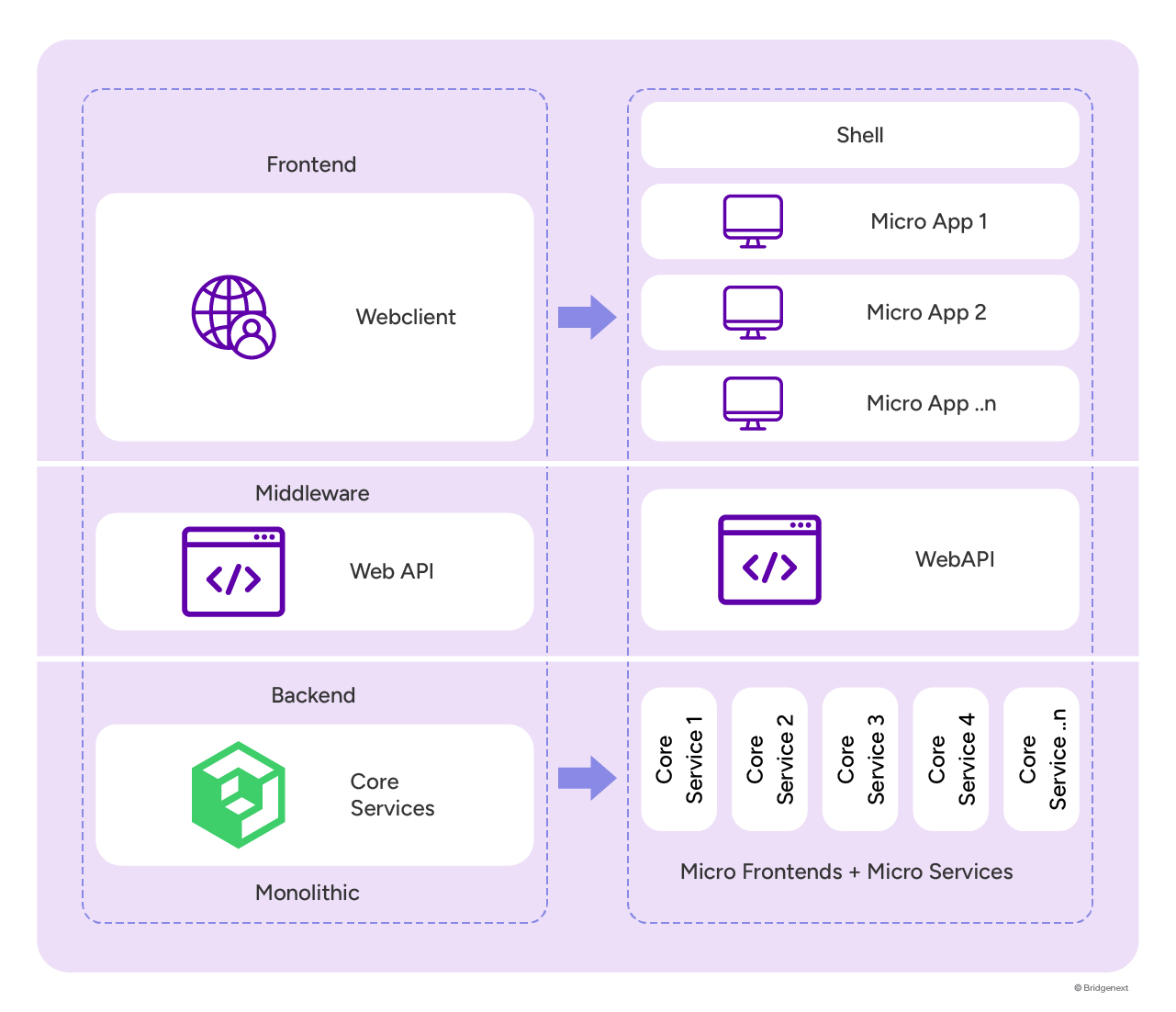
Bridgenext’s team worked as an extension of the client’s own, taking end-to-end ownership of the development lifecycle for each new micro-app. This collaborative model ensured knowledge transfer and alignment with the client’s long-term technology vision. The new architecture provided the freedom to utilize the best technology for each specific function, in this case, utilizing a combination of Single-SPA, React, and Backbone.js while maintaining a cohesive user experience.
-
Enabling Real-Time Customer Engagement & Analytics
With a modern, modular frontend in place, Bridgenext implemented a comprehensive real-time analytics and performance monitoring framework. Leveraging Google Analytics, Google Tag Manager, Data Studio, Optimize, Firebase, and Pendo, the team restructured tracking, built customized funnels for quote, booking, and shipping journeys, enabled GDPR-compliant data collection, and introduced self-service reporting and in-app guidance. This empowered their marketing and product teams with deep visibility into user behavior and product engagement while drastically reducing reliance on developers for insights and experimentation.
Together, these two initiatives created an agile, insight-driven digital platform that combined rapid innovation with intelligent customer engagement.

Results
The transition to a micro-frontend architecture was a strategic success, empowering the logistics leader to innovate at an unprecedented pace. The partnership delivered measurable improvements that reinforced the client’s market leadership and prepared them for future demands.
Their unified platform and data analytics transformation delivered strong business and technology outcomes:
- 70% YoY faster product development through parallel micro-frontend workstreams
- Significantly faster time-to-market with independent deployments, enabling continuous innovation
- 80% reduction in developer dependency across analytics and experimentation
- 100% test coverage with simpler, faster QA cycles
- Higher system resilience with fault-isolated micro-apps ensuring uninterrupted operations
- Improved retention strategies and customer satisfaction through personalized, data-driven insights
- Real-time visibility into user journeys, funnel performance, and product engagement
- Improved retention strategies and customer satisfaction through personalized, data-driven insights