02.18.26 By Bridgenext Think Tank

Most organizations realize that successful AI adoption requires choosing the right platform and ensuring data quality. Clean data is non-negotiable: no matter how sophisticated your AI, poor data leads to inaccurate or ineffective results. However, even with the best technology stack and robust data hygiene, a different challenge often makes or breaks an AI initiative: how people and processes adapt to change.
At a recent event on practical AI adoption, a key takeaway emerged: the hardest part of implementing AI isn’t the choice of platform or wrangling data, it’s overcoming resistance to new ways of working. Securing genuine employee buy-in is essential to avoid reverting to legacy processes. This blog explores why organizational change management (OCM) and process redesign are vital to unlocking ROI from AI.
Enterprises are relentlessly pursuing sharper platforms, better data, and forward-thinking AI roadmaps. Yet, progress stalls. This is not for technical reasons, but because entrenched processes, cultural habits, and misaligned incentives slow or even prevent adoption.
Leaders consistently underestimate:
Adoption is achieved only when employees trust new workflows and see personal value. This requires transparent communication about evolving responsibilities, redesigning incentives, and ensuring AI solution is seen as an enabler, not a threat.
If processes are flawed, AI just amplifies inefficiency. But even the strongest process redesign falters without accurate, accessible data. AI initiatives succeed when leaders clarify, before rollout:
Get ahead of these questions to turn AI into a catalyst for digital realization.
For more insights on building a foundation for sustainable, long-term transformation rather than isolated, short-lived wins: CIOs: Your AI Strategy Needs a Data-First Approach
AI projects stall when users don’t trust, don’t understand, or can’t see the benefits in their day-to-day roles. To drive engaged adoption, focus on three essentials:
Meaningful adoption comes when teams recognize the upside and influence of these shifts.
Consider a common operational workflow found across industries, managing process execution, monitoring performance, and resolving exceptions across interconnected systems and teams.
| Previous Workflow | With AI Integration | |
|---|---|---|
| Data Collection | Manual data entry from multiple systems and stakeholders; siloed information leading to inconsistencies and delays. | Real-time data ingestion from IoT devices and partner APIs; higher accuracy and visibility. |
| Exception Handling | Reactive issue management dependent on human monitoring and delayed escalation. | Proactive exception detection using predictive models; auto-flagging anomalies before disruptions. |
| Communication | Disconnected updates shared via emails, calls, and fragmented tools. | Context-aware, automated notifications delivered to relevant stakeholders through integrated collaboration platforms. |
| Approvals | Sequential, multi-layered approvals causing bottlenecks and slow decision cycles. | Intelligent, rules-driven routing that sends requests to the appropriate decision-maker based on context and thresholds. |
| Reporting & Compliance | Manual reporting, spreadsheet tracking, and time-consuming documentation. | Centralized dashboards, automated reporting, and explainable AI insights that strengthen governance and audit readiness. |
The shift isn’t just operational, it enables teams to focus on strategic decisions, achieve faster responses to disruptions, and measurably better customer satisfaction across industries.
This order matters. When organizations reverse it, AI becomes chaos.
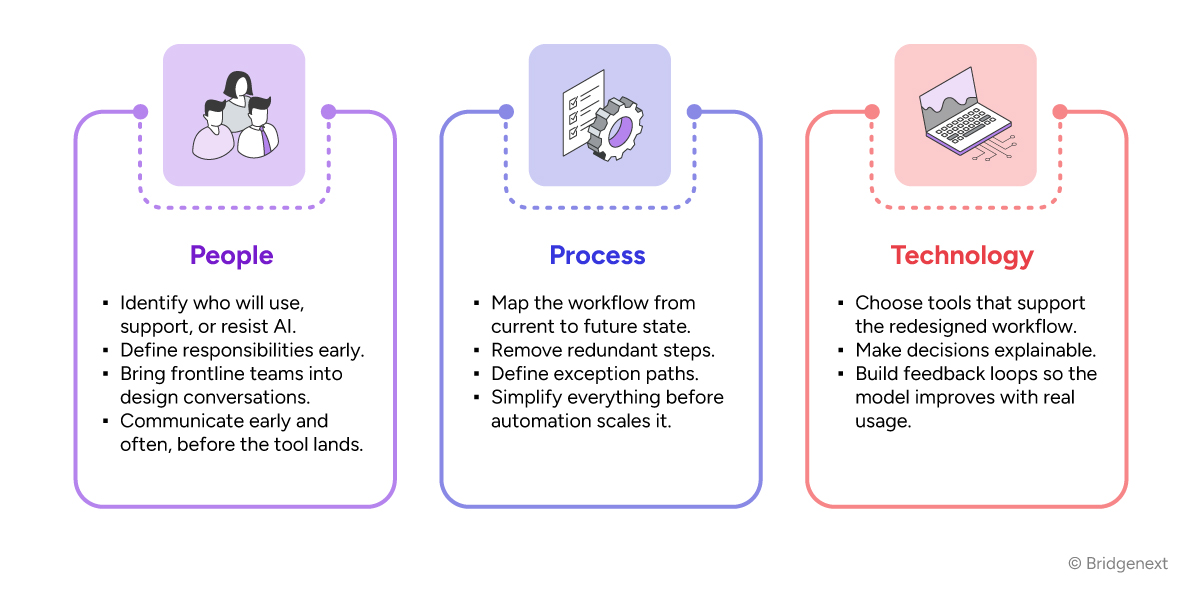
AI shouldn’t be a shiny object or a forced transformation. It should help teams work better, with more clarity, confidence, and control, using the systems you’ve already invested in.
Trust turns a pilot into sustainable improvement. When people understand and believe in AI-driven decisions, organizations benefit from faster cycles, lower error rates, higher productivity, and better customer results.
Governance, transparency, and explainability aren’t afterthoughts; they are essential growth levers as you scale. Organizations that succeed in AI move thoughtfully, invest in trust, and align systems and people toward shared outcomes.
Bridgenext delivers results-driven AI, not technology for its own sake. With an inclusive change management approach and focused adoption strategy, we help you get measurable business impact from AI investments.
Ready to architect a change management plan your teams will champion and your leaders can measure? Let’s talk.