11.20.25 By Nandakumar Sivaraman

According to the Marsh 2025 Technology Industry Risk Report, 79% of companies identify data security and privacy risks as a “high concern.” And it’s easy to see why. With AI models, intellectual property, and customer data flowing across hybrid environments at unprecedented speed, traditional Data Loss Prevention (DLP) systems, built on static rules and perimeter controls, are struggling to keep up. This creates a clear trade-off: speed versus safety, agility versus accountability.
Around boardrooms and leadership roundtables, the message is clear: it’s time to rethink DLP. The future lies in intelligence-driven protection, DLP powered by AI and ML, capable of predicting risks, understanding context, and scaling with innovation.
In this article, we’ll explore why this shift is happening now, the AI/ML techniques transforming DLP, and how high-tech enterprises can operationalize smarter, adaptive protection, without slowing innovation.
Code repositories, ML training datasets, and distributed cloud–edge architectures continuously generate, move, and expose sensitive data in ways legacy DLP models were never designed to handle. For a product engineering team that pushes code weekly to Git-based repositories or trains foundation models on multi-source data, the big data explosion translates into thousands of potential leakage points every day. Traditional, rule-based DLP systems, reliant on static patterns and human oversight, can’t keep up.
At the same time, AI and ML have introduced new risks. Picture an engineer pasting snippets of proprietary model weights into a third-party AI assistant or a marketing team uploading confidential customer data for campaign insights. The data trail is instant, invisible, and often irreversible. These aren’t isolated scenarios.
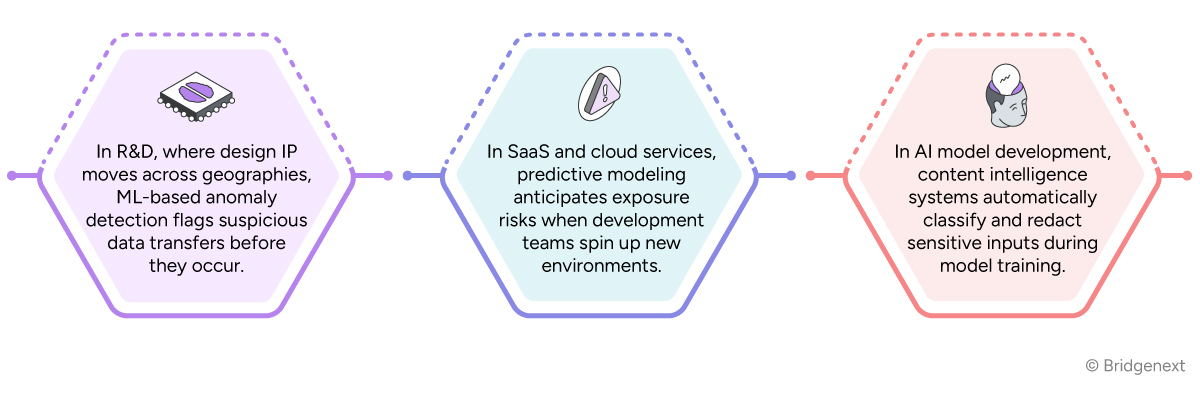
As regulatory requirements tighten, firms face mounting pressure to demonstrate data control without stifling innovation. Forward-thinking enterprises are realizing that the solution isn’t tighter gates, but smarter, adaptive protection. Below are real-world examples of how AI- and ML-driven controls quietly reshape data protection across the high-tech development lifecycle, well before full-scale DLP modernization programs are fully implemented.
Ultimately, innovation teams need security that scales with their pace, not one that constrains it. For modern enterprises, AI/ML–ML-enhanced DLP is rapidly becoming the foundation of secure innovation, a discipline that learns, predicts, and adapts alongside the business.
Let’s explore how advanced AI/ML techniques are transforming this landscape, turning DLP from reactive prevention into proactive intelligence.
Organizations must move beyond legacy DLP models, and here’s how smart techniques are leading the way:
Automated tagging and classification are becoming indispensable. For firms managing code repositories, ML datasets, and multimedia, this means gaining real-time visibility into what data exists and where it resides, at machine speed.
Traditional DLP rules often fall short when addressing subtle misuse and insider threats. By integrating behavioral analytics, such as user actions, access patterns, and device contexts, organizations can identify deviations and mitigate risks before significant losses occur.
Instead of reacting to leaks, predictive models enable organizations to anticipate risks. In risk management, AI-driven predictive analytics have been shown to improve loss prevention strategies. For enterprises, this means utilizing historical data and threat intelligence to identify high-risk data flows, enabling proactive mitigation rather than ad-hoc responses.
Scanning for keywords is no longer sufficient. NLP-enhanced anomaly detection frameworks can achieve detection accuracy while reducing false positives compared to older systems. This enables organizations to protect assets, such as proprietary code snippets or design images, with context-aware intelligence.
As these challenges grow, it’s clear that intelligent, AI- and ML-driven techniques are reshaping how high-tech organizations detect, classify, and protect data, whether in motion or at rest.
The most effective DLP frameworks aren’t stand-alone controls; they’re embedded across platforms, applications, and workflows. To succeed, executives must shift their focus from isolated tools to enterprise-wide orchestration: how AI/ML-driven DLP integrates seamlessly into existing infrastructure and scales effectively.
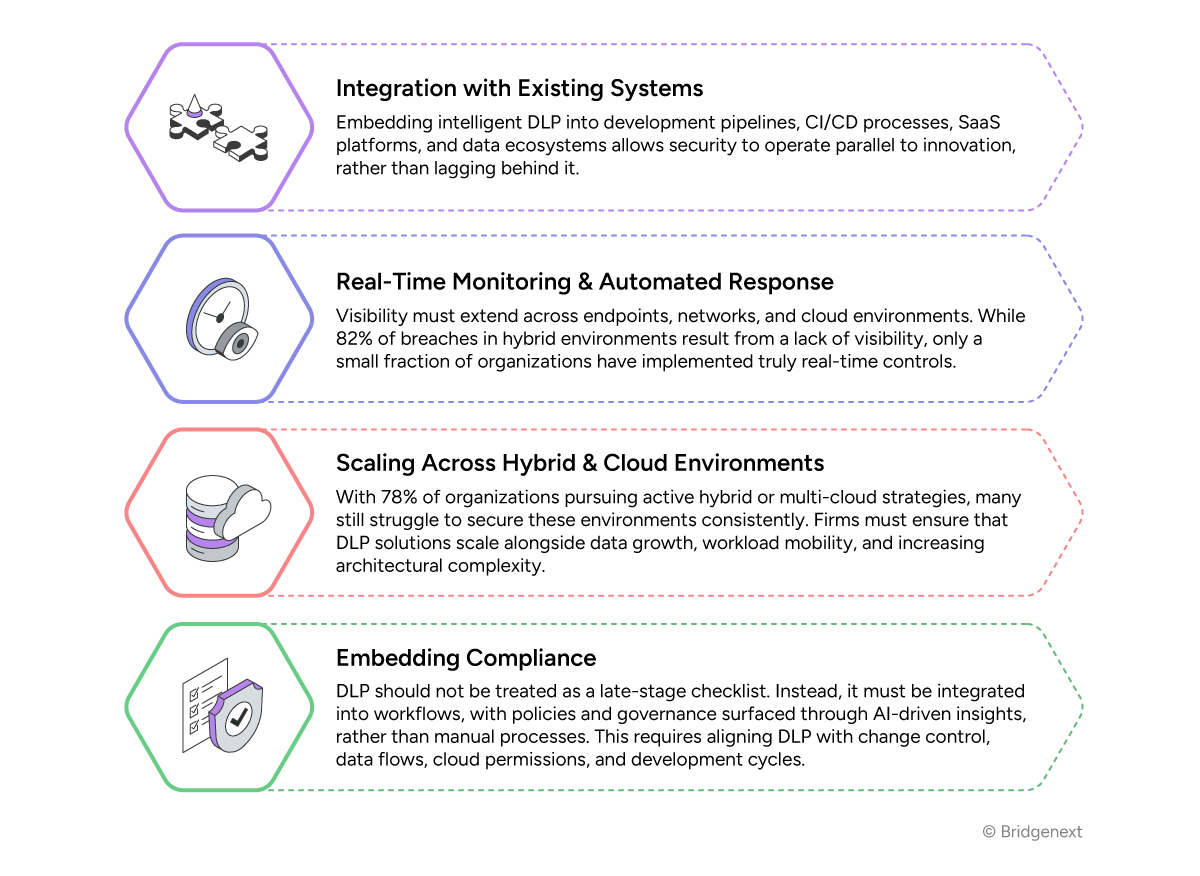
To achieve this transformation, companies must view DLP as a foundational element of their architecture. This involves consulting to define scope, integration, and scalable operations, rather than simply deploying a “DLP product.” With the techniques defined, the next challenge is to put them into action.
Enterprises are realizing that operationalizing AI-led DLP isn’t only about deploying a single tool; it’s about building strong foundations, tuning models to real workflows, and evolving policies to match how teams actually work. The organizations making the most progress are taking a phased, pragmatic approach anchored in discovery, experimentation, and cross-functional alignment.
Here’s how enterprises are putting AI/ML-enhanced DLP into action:
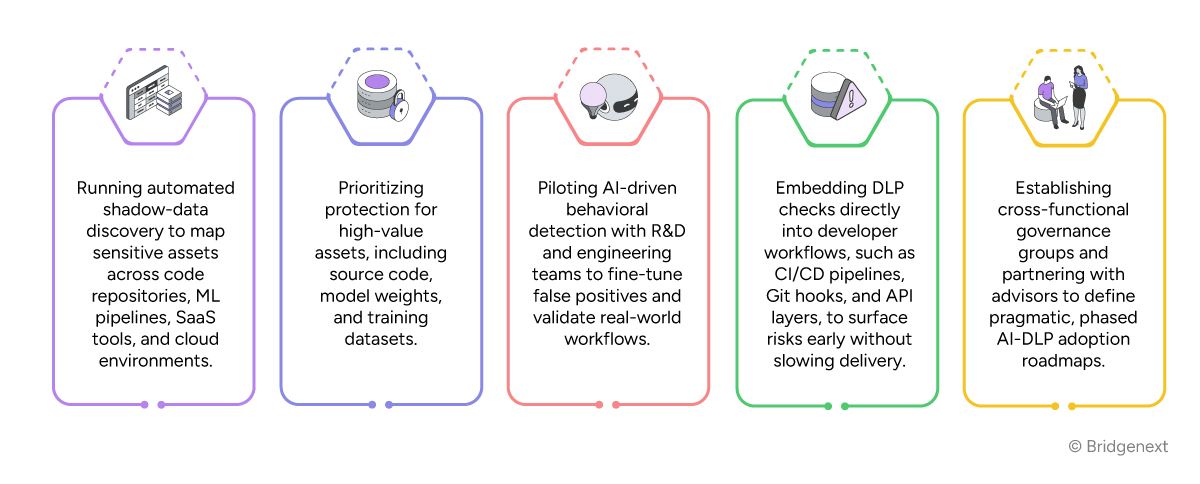
Together, these practices reflect a shift to practical execution, where AI-driven DLP becomes a living, evolving capability shaped by real usage patterns and organizational realities. As enterprises mature, the focus shifts from simply preventing data loss to enabling secure innovation at scale.
As AI and automation advance, DLP is evolving from a reactive safeguard into an adaptive, intelligence-driven defense. The future lies in Policy-as-Code, where adaptive AI dynamically aligns security with business priorities and adjusts thresholds based on user behavior. Multimodal, context-aware DLP will expand protection to include code, multimedia, and AI-generated content, domains that are especially critical across all industries. With integrated threat intelligence and federated learning, DLP becomes a continuous, collaborative system.
At Bridgenext, we help organizations anticipate these shifts, assess readiness, and architect scalable, future-ready data protection frameworks.
Data Loss Prevention is no longer just a compliance requirement; it’s a cornerstone of digital trust and enterprise resilience. AI and ML are transforming how organizations safeguard their most valuable digital assets. However, success depends not only on technology itself, but also on the thoughtful adoption of these innovations. For technology-forward enterprises, a pragmatic, phased approach, rooted in strategy, readiness, and modernization, can elevate DLP into a true competitive advantage.
At Bridgenext, we help enterprises think strategically, plan confidently, and prepare effectively for the next generation of AI-powered data protection. In an era where data is both an asset and a risk, foresight remains the ultimate safeguard.
Connect with our data experts to discuss your DLP needs.
References:
www.marsh.com/en/industries/technology/insights/tech-risk-study.html
www.deloitte.com/us/en/insights/industry/technology/bridge-data-privacy-concerns-in-women-with-technology.html
link.springer.com/chapter/10.1007/978-3-032-06665-7_28
it-online.co.za/2025/09/29/smes-need-data-loss-prevention-in-the-age-of-ai/
www.cybersecurity-insiders.com/data-security-report-2025-are-traditional-dlp-solutions-a-barrier-to-preventing-data-loss/