03.18.26 By Bridgenext Think Tank

Top-tier wealth managers set themselves apart by delivering keen, proactive guidance and insights for their clients, empowering them to make smart, timely decisions. Yet, delivering that level of service demands seamless access to near real-time data. In reality, most wealth and asset management organizations have data scattered across platforms, reports, and teams, which often results in fragmented insights, delayed answers, and missed opportunities. This industry-wide challenge isn’t just about information overload, but about the lack of unified, actionable insight when it matters most.
Most wealth management organizations are rich in data but poor in accessibility. You likely have a CRM for client interactions, a separate system for portfolio accounting, another for risk analysis, and perhaps spreadsheets for ad-hoc reporting.
While these tools perform their specific functions exceptionally well, they often don’t speak to one another effectively. Data remains locked within systems, slowing the flow of information between advisory, investment, and risk teams.
When analytics stops at just reporting, the consequences are subtle but significant:
The goal is to ensure you never miss a single client opportunity because data was “a little here and there.” The solution lies not in replacing your current high-performing platforms, but in unified connectivity.
The gap in modern wealth management infrastructure is rarely an application gap; it is a data integration gap. To bridge this, forward-thinking firms are adopting an enterprise data layer. This is a unified foundation that allows data to move freely, securely, and instantly across functions.
This approach expands the concept of governance beyond technical controls. It’s not just about lineage, access, or auditability (though those remain essential). True enterprise data governance means establishing clear data ownership, appointing domain stewards across advisory, investment, risk, and finance, and aligning teams with shared data definitions and business glossaries. Policy-driven access, where roles, entitlements, and usage policies are embedded at the data layer, ensures data is consumed appropriately and confidently throughout the organization.
A robust enterprise data layer, therefore, enables coordinated stewardship, shared understanding, and the agility to evolve policy as regulations or business needs shift, all while maintaining a single source of truth for critical analytics and decision-making.
This is where platforms like Databricks add immense value, acting as the missing link in your analytics strategy.
Think of Databricks not as a replacement for your CRM or risk engine, but as the central nervous system that connects them. It sits above your source systems and below your analytics dashboards, bringing client, portfolio, transaction, market, and risk data into a single, governed environment often called a “Lakehouse.”
It doesn’t replace existing platforms, it connects them, creating a consistent foundation for analysis across the firm.
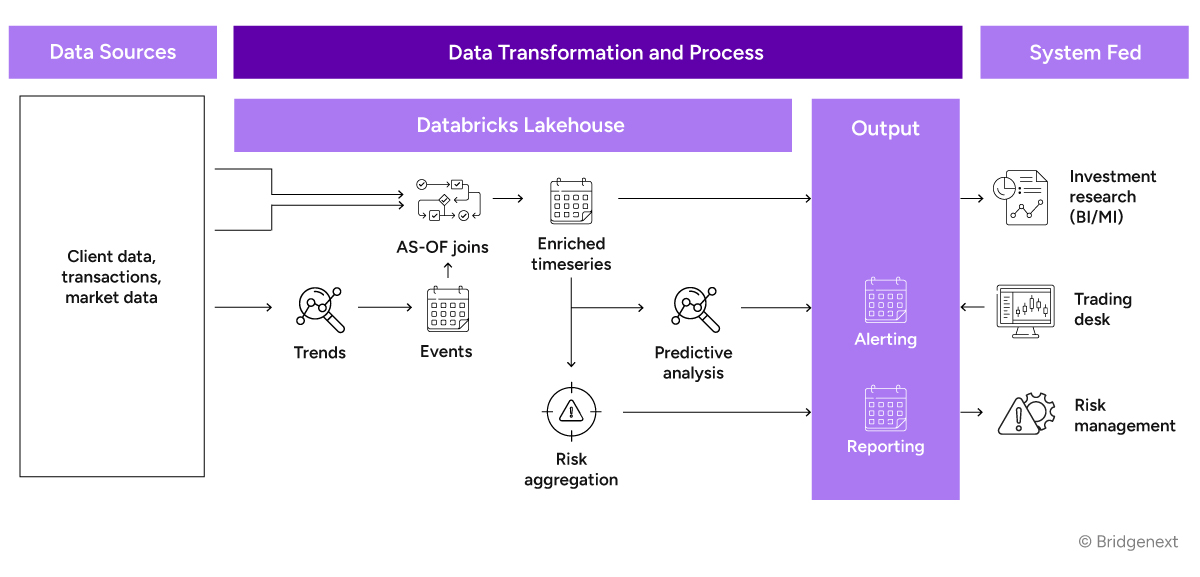
By implementing this unified layer, wealth firms can:
Databricks does not replace your CRM, portfolio management, risk engines, or BI tools. It connects them, so enterprise data can be used with greater speed, consistency, and confidence.
Most wealth firms already capture client, portfolio, transaction, and market data across mature systems. The differentiator is not only having the data, it’s the ability to trust and leverage that information rapidly enough to deliver higher-value client service and fuel new revenue opportunities. A systematic data engineering solution with unified data layer empowers teams to act in real time with clarity and confidence, transforming internal analytics into actionable insights for both client-facing and operational outcomes.
This unified approach doesn’t just improve data accessibility, it brings measurable gains in cost and operational efficiency. Firms can consolidate analytics workloads onto a single platform, reduce costly data duplication, and improve transparency into compute usage and resource allocation. CIOs and CFOs also gain the ability to see where analytics investments are working, optimize infrastructure spend, and support growth without hidden inefficiencies or budget surprises.
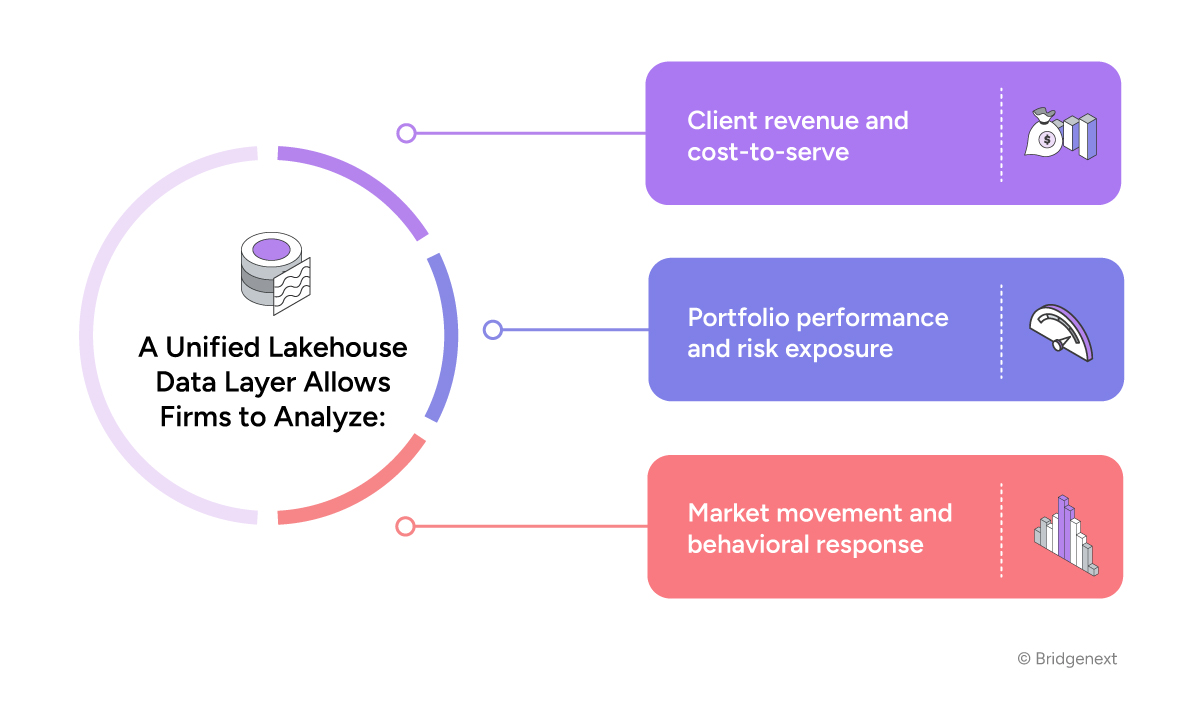
A unified Lakehouse data layer allows firms to analyze:
When your data is unified, your workflow evolves from reactive to proactive:
This empowers advisors to deliver richer, higher-value services. Instead of spending time gathering data to prepare for a review, they can spend that time crafting sophisticated financial strategies that deepen the client relationship.
How do you know if your firm is ready to make this leap? Senior leaders can assess their current data maturity by asking four critical questions. Firms that score well here are positioned to turn analytics into a true competitive advantage.
| Dimension | The Goal | What to Assess |
|---|---|---|
| Decision Latency | If a market event happens this morning, your advisors should understand the impact on their clients by this afternoon, not next week. | How quickly can your insights reflect market movements or changes in client behavior? |
| Data Connectivity | You should be able to view a client’s holistic financial picture across all asset classes and liabilities without logging into five different systems. | Can client, investment, and risk data be analyzed together without duplication or manual effort? |
| Governance by Design | Compliance should function as an automated guardrail, giving you the confidence to use data freely without regulatory anxiety. | Are lineage, access controls, and auditability embedded in the analytics process, or are they manual checks added later? |
| Analytics Leverage | Your brightest mind should be focused on wealth strategy, not data janitorial work. | How much time do your high-value teams spend preparing data versus using it to influence decisions? |
The strongest wealth firms we speak with have already invested heavily in platforms, reporting tools, and analytics. They are not starting from scratch. What they’re wrestling with now is something more nuanced: how to connect all that enterprise data into a single, trusted analytical layer that supports revenue growth, risk visibility, and better client decisions at the same time.
That’s where integrating in a data overlay becomes powerful. When the heavy lifting of data aggregation, normalization, and advanced analytics is handled in a unified environment like Databricks, your advisors aren’t chasing reports. They’re having better conversations. Your risk teams aren’t validating spreadsheets. They’re identifying exposure earlier. Your leadership team isn’t debating whose numbers are correct. They’re acting on insight.
At Bridgenext, we spend time understanding how your advisors work, how your investment teams analyze performance, how your compliance leaders think about risk. Then we align the data architecture to support those realities. We’ve partnered with firms to reduce turnaround time on reporting, streamline advisor access to holistic client views, and create analytical foundations that scale with growth, without adding operational drag.
If your data feels “almost there” but not quite enabling the speed and clarity you want, it may be time to step back and reassess the architecture behind it. A Bridgenext Data Strategy & Assessment is designed to do exactly that, evaluate how well your current environment supports revenue visibility, advisor effectiveness, and confident decision-making.
The goal isn’t more technology. It’s sharper execution, faster insight, and a stronger client experience built on data you can trust. Explore the Bridgenext & Databricks Partnership and connect with us to discuss how we can help your team develop deeper client relationships.