10.01.25 By Curtis Cochran

Most leaders will tell you customer personalization is a top priority, and it should be. Retaining a customer is 5x cheaper than acquiring a new one, and today’s buyers expect experiences that feel tailored to them.
That’s why companies have poured money into AI recommendation engines, dynamic email platforms, customer data platforms, and real-time content tools. Yet, the frustration remains the same:
“We invested in personalization… but we still don’t really know who our audience is.”
If that sounds familiar, you’re not alone. Personalization tools are everywhere, but conversions often stay flat. Why? Because the foundation is missing.
Before tools, before campaigns, before data science, you need audience frameworks and analysis.
Think of the last time you got a “personalized” message that felt completely irrelevant, maybe your bank offered you a mortgage even though you just bought a home, or your favorite retailer kept promoting products you’d already purchased.
That disconnect happens because personalization is being run on autopilot. Companies push messages without alignment on who they’re actually speaking to. The results:
Even the most advanced Customer Data Platforms (CDP) or Machine Learning (ML) engine can’t fix this. If you’re talking to everyone, you’re not convincing anyone.
An audience framework is a data-driven map, commonly offered as part of marketing personalization services that defines exactly who your customers are, how they behave, and how they convert. It’s more than just a set of demographics or basic segments; it’s a comprehensive asset that enables you to activate insights across all touchpoints.
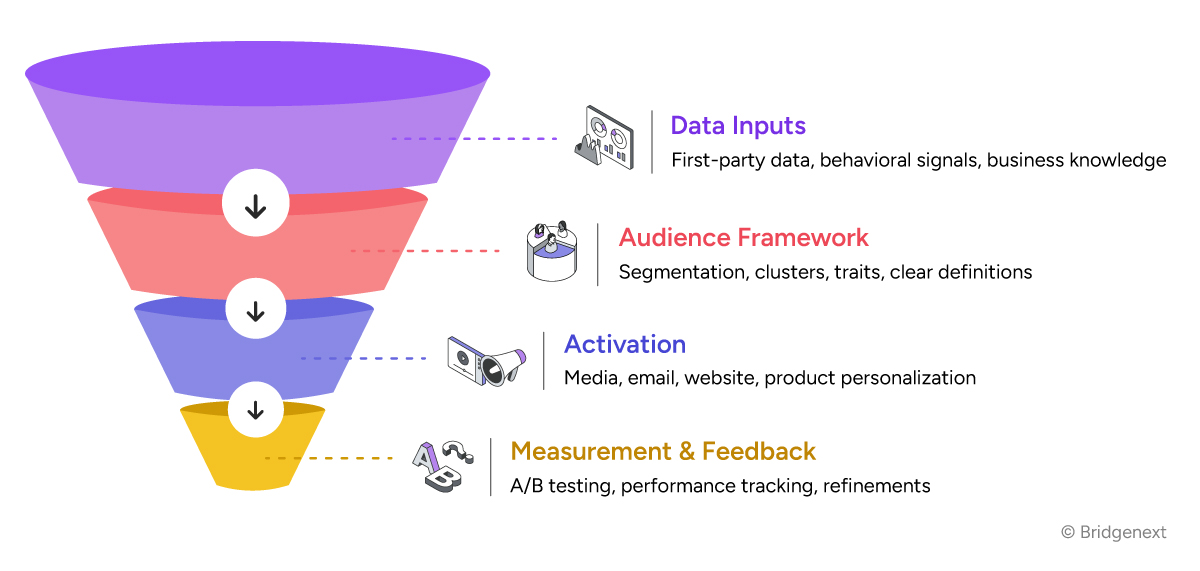
An audience framework isn’t a slide in a marketing deck. It’s a data-backed map of:
Done right, it becomes the “power grid” behind personalization, fueling every channel, every touchpoint, and every campaign.
Strong audience frameworks are:
This is the piece most organizations miss. They treat audiences as campaign input when they should treat them as a strategic asset.
| Approach | How It Works | Key Actions |
|---|---|---|
| Manual + Strategic | Grounded in business knowledge and stakeholder input |
|
| ML-Powered Segmentation | Data-driven clusters surfaced by machine learning |
|
Pro tip: The strongest frameworks combine both, let strategy inform the models, and let models uncover blind spots.
An audience framework sitting in a digital experience strategy deck won’t deliver business results. Its true value appears when it powers execution, when every customer touchpoint becomes sharper, more relevant, and more efficient.
A specialty retailer used cluster analysis across store-performance, loyalty, competition, and staff data to pinpoint high-ROI markets, improving how they allocate marketing spend.
Read more → Specialty Retailer Elevates Marketing ROI Using Cluster Analysis
A wholesale distributor unified fragmented data systems and built automated, segmented email campaigns to drive higher engagement and retention.
Read more → Driving Scalable Customer Engagement Through Marketing Automation and Data Strategy
When the right message hits the right person at just the right moment, conversion happens naturally. That’s the kind of efficiency audience frameworks make possible.
One of the biggest mistakes organizations make is treating an audience framework as a one-time project. But audiences aren’t static, they evolve with shifting markets, new competitors, and changing customer behavior. If your framework doesn’t evolve too, your personalization efforts will quickly lose relevance.
High-performing companies embed measurement and optimization loops into their personalization strategy from day one. That means:
Without this discipline, you risk overlapping segments, attribution blind spots, and conflicting definitions of value across marketing, media, and CRM. With it, you unlock what executives actually care about: repeatable ROI, scalable growth, and personalization that compounds over time.
The future of personalization won’t be won by the brand with the flashiest AI tool. It will be won by the brand that knows its audience better than anyone else. Audience frameworks are how you get there. They give you the clarity to cut through noise, activate with precision, and finally make personalization live up to its promise.
With Bridgenext’s digital experience consulting, we help organizations start with the data they already have, design frameworks that uncover what truly matters, and put them into action where it counts.
Ready to find out if your personalization is actually working?
Schedule an Audience Framework Assessment with our Customer Experience Strategists and see where the gaps are, and how to close them. Book a Strategy Call Today.