04.01.26 By Foster Kaman

Technology spending across logistics and supply chain organizations continues to rise, and rightly so. The operating environment demands it. Volatility has become constant, cost predictability is harder to maintain, and customer expectations around speed and visibility have tightened to the point where they are now baseline requirements.
Yet despite this increased investment, many leadership teams still struggle to clearly articulate what has materially improved.
This is the paradox. It is not that organizations are spending too little on IT. In most cases, they are spending more than ever. The issue is that these investments are often made in isolation, without a unified view of how they collectively impact operations.
What emerges over time is a fragmented ecosystem:
The result is disconnected value across the transportation and logistics ecosystem. Technology exists across the organization, but its ability to move key metrics; cost per shipment, quote turnaround time, service reliability, or lane-level profitability remains limited.
In 2026, aligning IT spend is less about adopting new tools and more about ensuring every investment is directly tied to speed, accuracy, cost efficiency, or revenue impact.
A consistent pattern across logistics organizations is the proportion of IT budget allocated to maintaining the current state. Legacy TMS and WMS platforms, complex integrations, and reporting environments continue to demand significant investment simply to remain operational. While necessary, this “run” spend often crowds out investments that could improve how the business actually performs.
The shift leading organizations are making isn’t dramatic in scale, but it is clear in intent, moving from maintenance-led spending to modernization tied to specific operational outcomes.
A practical example is Transportation Insight’s modernization initiative with Bridgenext. The focus wasn’t a generic data platform upgrade, but a business constraint: fragmented data and slow reporting were limiting timely decision-making.
By implementing a unified, cloud-native data architecture, the organization was able to:
It’s a clear example of what happens when IT investment is aligned to a measurable business need. Across engagements, the pattern is consistent, anchor investments to a constraint, and impact follows quickly.
A similar approach applies to integration-led modernization. One transportation company operating on legacy systems faced delays across TMS, WMS, and finance platforms, leading to manual reconciliation and inefficiencies.
Instead of replacing systems, the focus was on integration and workflow alignment. By introducing a modern integration layer:
The takeaway is simple: value doesn’t always come from adding new platforms, but from making existing ones work together effectively.
Another challenge that often goes unexamined is spend efficiency. Most organizations have visibility into total IT spend, but far fewer understand how that spend translates into competitive positioning. Without benchmarks, it becomes difficult to assess whether the organization is investing for advantage or simply maintaining parity.
In many cases, organizations are not underinvesting. They are overpaying for limited impact, largely due to inefficiencies in how their technology landscape is structured.
Before committing to large transformation programs, there is significant value in taking a structured, non-biased look at the current environment. In most cases, meaningful improvements can be unlocked without introducing entirely new platforms.
A focused optimization audit typically reveals opportunities across three areas:
It is common to find multiple tools addressing similar use cases without integration. This creates unnecessary cost and limits visibility.
Many organizations still rely on batch-based or end-of-day reporting, which limits their ability to act in real time.
Generative AI solutions and automation often exist but are focused outside core processes.
Not all vendors/partners contribute equally to business outcomes.
Often overlooked, these optimizations can generate immediate savings. More importantly, they create capacity, both financial and operational, to invest in higher-impact initiatives such as AI-driven route optimization or automated warehousing.
The organizations leading in 2026 won’t necessarily be those with the most advanced technology. Instead, they will be the ones who have strategically aligned their technology stacks with their business operations.
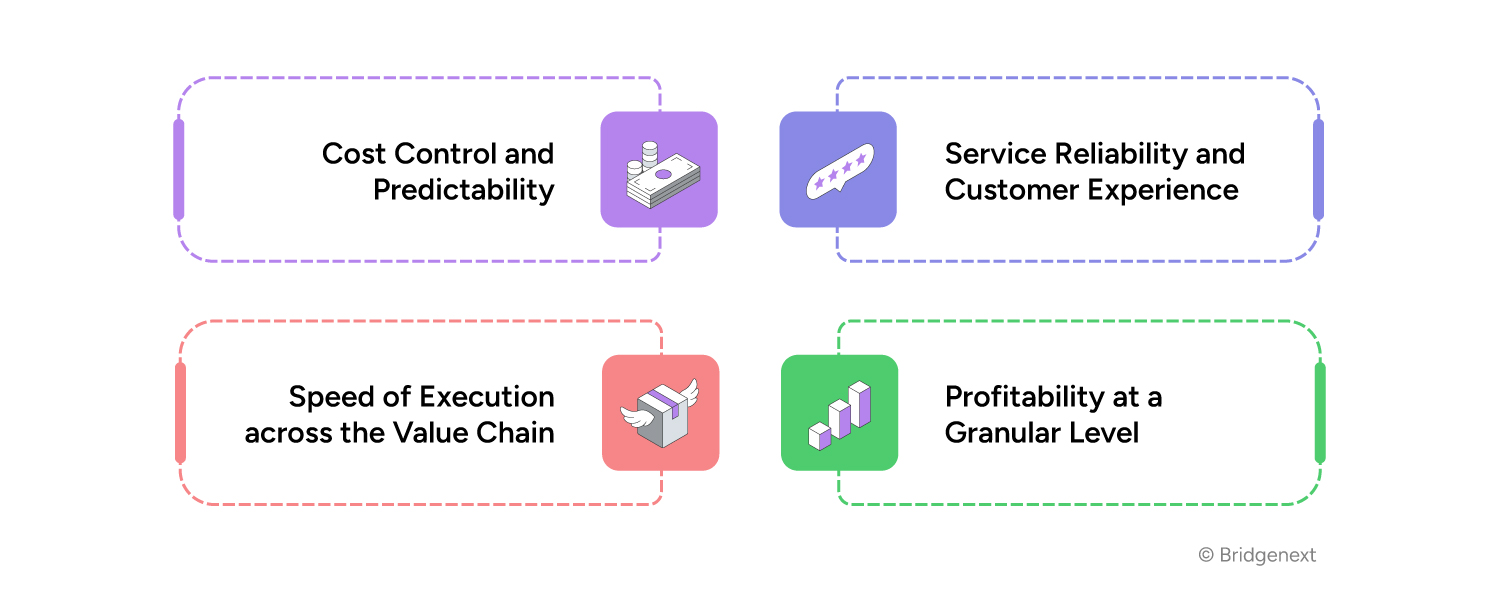
This shifts the role of IT from a support function to a direct and critical contributor to:
As you approach your next planning cycle, it’s time to shift the conversation from a working tech stack to a winning one. The key isn’t just to identify the next tool to invest in (e.g. AI FOMO), but to pinpoint which business outcomes require improvement and how technology can be strategically leveraged to drive those results.
For organizations looking to take a more structured approach, the starting point is a focused evaluation of where current investments are underperforming and where quick, measurable gains can be achieved.
Schedule a 30-minute strategy call with Bridgenext to begin to identify opportunities where:
With a clear objective: deliver measurable impact within the next two quarters.
Your edge will come from making sure every tech investment you make directly improves how your business works and creates value.