11.12.25 By Nandakumar Sivaraman

The pressure on technology leaders to deliver an impactful AI strategy is undeniable. Generative AI has rapidly moved from niche pilots to an enterprise-wide demand, creating a powerful “demand pull” from business units eager to leverage its capabilities. This democratization of AI is exciting, but it also presents a significant challenge.
Too many organizations are rushing into AI investments, driven by vendor hype or a fear of falling behind competitors, without first building a solid data foundation. This approach often leads to wasted resources, significant technical debt, and a failure to achieve the transformational business outcomes AI promises. This post provides clear, expert answers to the most pressing questions CIOs face, offering a practical roadmap for developing an effective Data Analytics and AI investment strategy that starts with data and aligns with long-term business goals.
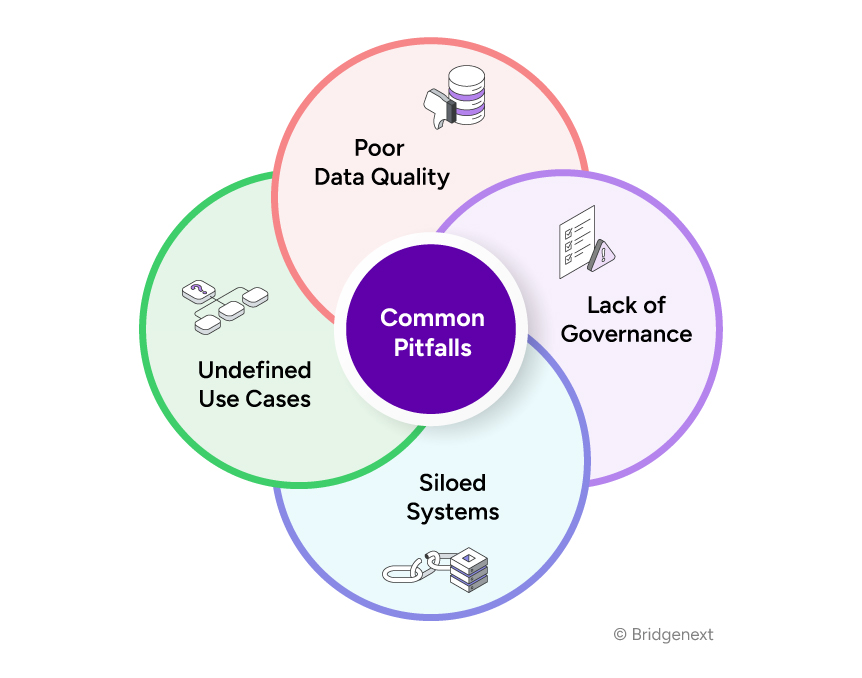
Looking to the market for direction can blind CIOs to their own organization’s context. Implementing vendor “solutions” without assessing your current data landscape, governance, and use-case feasibility often leads to misaligned efforts, wasted spend, and burdensome technical debt.
Actionable Takeaway: Audit your data assets, governance maturity, and process realities first. Identify where measurable outcomes map to genuine business needs—then consider external technology or case studies.
Pursuing disconnected AI initiatives creates confusion, encourages overspending, and delivers a low return on investment. The primary risks fall into three categories:
A balanced scorecard of strategic and operational indicators is essential to move beyond vanity metrics. The goal is to measure tangible business performance, not just technical deployment.
| Category | Key Metrics | Business Impact |
|---|---|---|
| ROI & Productivity | Margin growth, throughput, utilization | Quantifies economic benefit |
| Process Improvement | Error reduction, cycle time | Drives operational excellence |
| Customer Impact | NPS, CSAT, time-to-market | Measures external value |
| Workforce Enablement | Adoption rate, training completion | Ensures human-AI synergy |
Actionable Takeaway: Align these metrics to your quarterly goals. Set baselines in advance, and use control groups to isolate and defend AI’s value.
The key is to start small, scale with intention, and involve the business at every step. This builds a foundation for sustainable, long-term transformation rather than isolated, short-lived wins.
“AI isn’t just about automation; it’s about reimagining how work gets done.”
It is a double-edged sword. The opportunity is real, but over-simplified hype can lead leaders to miss essential foundations, most critically, data readiness.
Actionable Takeaway: Embed AI within your digital strategy, but always through a data lens. Successful organizations know that without reliable data, AI investments are not sustainable.
For a deeper perspective on how enterprises can translate these priorities into actionable outcomes, there’s a very insightful blog written by Bridgenext Data expert, Nandakumar Sivaraman, on this very subject: Unlocking AI’s Potential: Insights from Nandakumar Sivaraman
Connecting these insights to action requires focusing investment on the foundational pillars that enable AI success. According to a recent MIT Technology Review Insights survey, leading organizations that are already seeing returns from AI report that “Democratizing data access” and “Business intelligence infrastructure” are their most instrumental investment areas.
Many enterprises have learned the hard way: large digital-transformation spends don’t always translate into meaningful business outcomes. The same risks now face leaders rapidly investing in AI. Without strong data foundations and a pragmatic roadmap, even the most promising initiatives can stall or fail to scale.
Success in AI isn’t about racing to deploy the newest models, it’s about making smart, durable investments through a phased, collaborative approach that balances near-term value with a long-term innovation vision.
A flexible, scalable data architecture is the difference between AI that transforms your business and AI that never leaves pilot mode. It is the engine that powers insights, automation, and growth.
At Bridgenext, we’ve helped CIOs and business leaders avoid repeating the mistakes of past transformation efforts, by first establishing a resilient data and AI foundation without requiring deep in-house data engineering expertise. They leverage our proven frameworks, accelerators, and talent to drive outcomes that matter.
If you’re ready to move beyond hype and build an AI strategy grounded in practicality, resilience, and long-term value, let’s talk.
Contact us to partner with our data + AI team to build a foundation designed for today’s challenges, and tomorrow’s opportunities.