10.18.25 By Bridgenext Think Tank

Once seen purely as a cost-saving measure, digital product outsourcing has evolved into a strategic growth enabler. Amid economic uncertainty, increasing data sovereignty pressures, and the rapid advancement of AI-driven development, today’s CXOs face a new question: not whether to outsource, but how to do so intelligently. The challenge now lies in achieving the right balance between control, compliance, and co-creation – partnering with technology providers who go beyond delivering code to share genuine accountability for business outcomes.
Let’s set the record straight: outsourcing isn’t broken, it’s evolving into innovation-led collaboration. The next generation of digital product engineering partnerships thrives on common goals, transparent delivery, and producing measurable business impact.
In this blog, we’ll explore how forward-thinking enterprises can harness modern engagement models and technology to transform outsourcing from a cost center into a competitive advantage.
As we approach 2026, the pace of digital transformation continues to accelerate. Driven by technological advancements and dynamic market demands, enterprises are investing heavily in modernizing their digital products and services. Indeed, global digital engineering spend reached approximately $2.2 trillion in 2023 and is projected to reach around $3 trillion by 2027.
Staying ahead requires a strategic understanding of the forces shaping our industry. This section will delve into the critical trends poised to redefine digital product engineering, offering insights essential for forward-thinking enterprises aiming to optimize their innovation trajectory and deliver superior value. Key trends shaping digital product engineering include:
AI/ML, generative models, and predictive analytics have transitioned from experimentation to expectation. Engineering teams are now embedding AI copilots into the development process – boosting productivity, improving decision-making, and accelerating release cycles. Data pipelines and feedback loops power adaptive, learning-based products that evolve with user behavior.
Legacy applications are being reimagined using containers, microservices, service meshes, and Kubernetes. Cloud-native architectures enable agility, scalability, and resilience while simplifying maintenance and release management. When combined with edge computing, they drive a new wave of always-on, high-performance digital experiences.
Security-integrated CI/CD pipelines, automated test suites, and autonomous code testing are redefining the speed and quality of software delivery. Automation not only enhances efficiency but also safeguards integrity. With DevSecOps integrated into every stage, teams can iterate faster while minimizing vulnerabilities and ensuring compliance.
Platform engineering is emerging as the backbone of digital agility. By creating reusable frameworks and accelerators, enterprises streamline delivery across teams and geographies. Meanwhile, Global Capability Centers (GCCs) and decentralized developer networks are reshaping the outsourcing ecosystem, uniting distributed talent pools through shared governance, design systems, and knowledge hubs.
The rise of real-time collaboration platforms and agile governance models has transformed the performance of distributed teams. Transparent workflows, shared dashboards, and automated reporting ensure alignment between business and engineering, eliminating silos and fostering a culture of shared accountability.
Models such as Build-Operate-Transfer (BOT) and hybrid sourcing offer the best of both worlds: expert execution today and long-term ownership tomorrow. These models enable enterprises to scale rapidly while internalizing critical capabilities such as platform engineering, data operations, and AI innovation.
Each of these trends highlights a larger shift: success in 2025 will depend on the ability to fuse advanced technologies (AI, cloud, automation) with modern operating models (DevSecOps, BOT, decentralized teams) to drive continuous innovation and deliver measurable business value.
Today, both enterprises and high-growth startups are partnering with product development experts who not only deliver efficiently but also share accountability for achieving business outcomes. A recent survey by Clutch revealed that nearly 80% of technology leaders plan to increase their reliance on third-party engineering partners for business-critical initiatives, indicating that outsourcing has become integral to growth and resilience.
Modern outsourcing partnerships deliver measurable business impact across several key dimensions:
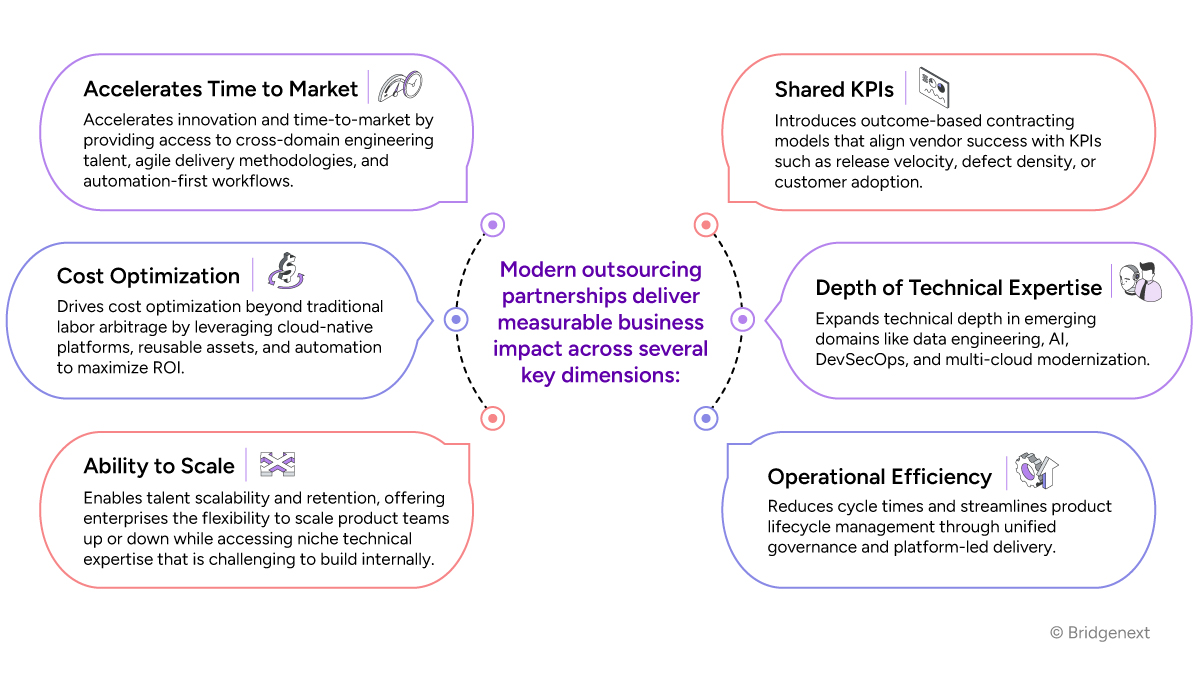
When done right, outsourcing is not about offloading work; it’s about extending capabilities. The right partner co-owns your vision, matches your velocity, and transforms your digital products into a sustained competitive advantage.
Today’s IT and business leaders expect far more from a product engineering partner than mere execution. They seek a collaborator who functions as an extension of their team, bringing strategic clarity, engineering expertise, and a culture of continuous innovation. The ideal partner doesn’t just build products; they co-create digital advantage through shared ownership, transparency, and proactive technology leadership. To truly deliver value, an outsourced digital engineering partner must:
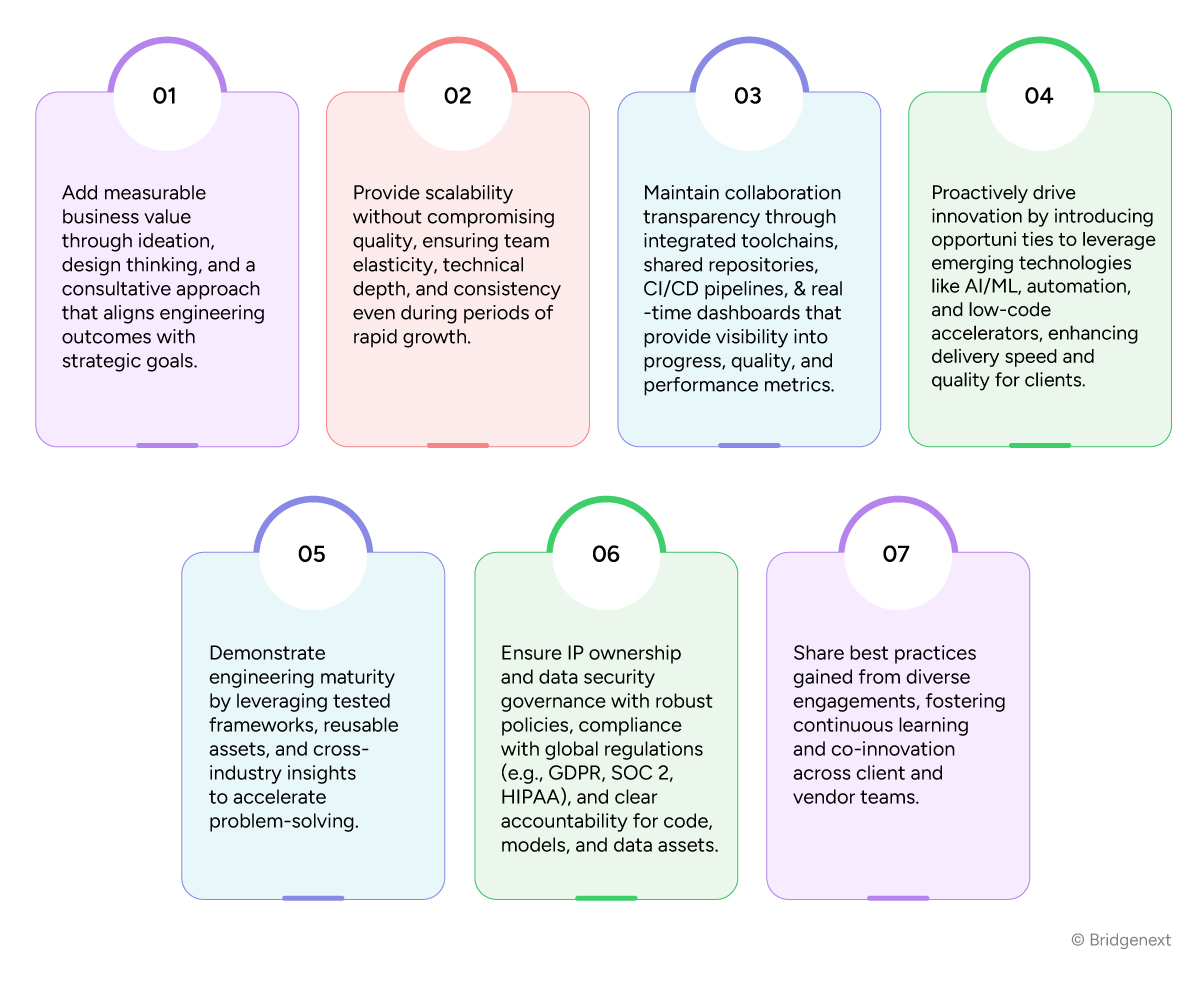
Modern product engineering partnerships thrive on trust, transparency, and technical foresight. Clients expect partners who not only deliver on today’s roadmap but also anticipate tomorrow’s opportunities—helping them stay ahead of disruption.
The success of an outsourced product development initiative begins with clarity. Before selecting a partner, define the core purpose of the engagement—are you seeking a tactical application vendor to manage specific development streams, or a strategic partner capable of co-owning the entire product lifecycle, from ideation to modernization?
Once your objectives are clear, evaluate potential partners through the following key criteria:
Assess whether the partner has the engineering depth, scalable infrastructure, and robust security posture required to translate your product vision into reality.
Look for partners proficient in modern architectures—cloud-native, multi-cloud, and API-first—with proven expertise in open-source and plug-and-play ecosystems.
True success hinges on how well the partner integrates with your team’s working styles, governance models, and agile delivery practices.
Seek a partner that brings thought leadership—one that can contribute to your roadmap, anticipate disruptions, and continuously evolve your product with emerging technologies like AI/ML, automation, or DevSecOps.
Evaluate the onshore, nearshore, and offshore mix to achieve an optimal balance of cost, collaboration, and risk mitigation. Diversify delivery locations and vendor portfolios to reduce concentration risks.
Move beyond traditional Proof of Concept (PoC) toward Proof of Outcome (PoO), measurable business results tied to defined KPIs and SLAs that align with your strategic goals.
Look for partners who offer adaptable engagement models, such as Build-Operate-Transfer (BOT) or hybrid multi-vendor setups – that provide both agility and long-term control.
Outsourcing in 2026 and beyond is no longer just about cost efficiency; it’s about long-term business strategy, resilience, innovation, and measurable results. Avoid partners who are order takers and look for those who align with your shared vision of growth and innovation.
Their strength lies in transforming abstract ideas into tangible, market-ready solutions. Success also hinges on cultural alignment and a shared long-term vision, with sustained performance being the ultimate measure. A reliable partner accelerates your ability to innovate, modernize, and scale with confidence. The most successful outsourcing partnerships are built on shared accountability, co-innovation, and continuous evolution.
At Bridgenext, we build trusted partnerships that extend beyond product delivery. We create digital advantage, enabling high-tech businesses to commercialize ideas faster, operate smarter, and stay ahead of disruption. Connect with our team to explore how we can help.
References
winatalent.com/blog/2020/01/why-software-development-outsourcing-fails/
www.prnewswire.com/news-releases/appetite-on-digital-engineering- spend-is-on-the-rise-as-companies-continue-to-strengthen-their-technology-arsenal-to-future-proof-businesses-from-covid-19-and-beyond-says-zinnov-301313743.html
clutch.co/bpo/resources/benefits-of-outsourcing
www.gartner.com/en/articles/2025-trends-for-chief-product-officers
forbespanama.com/rethinking-outsourcing-the-worth-of-tech-enabled-strategic-development-partnerships/